Understanding the 4-4-1-1 Formation: The Shadow Striker System Explained
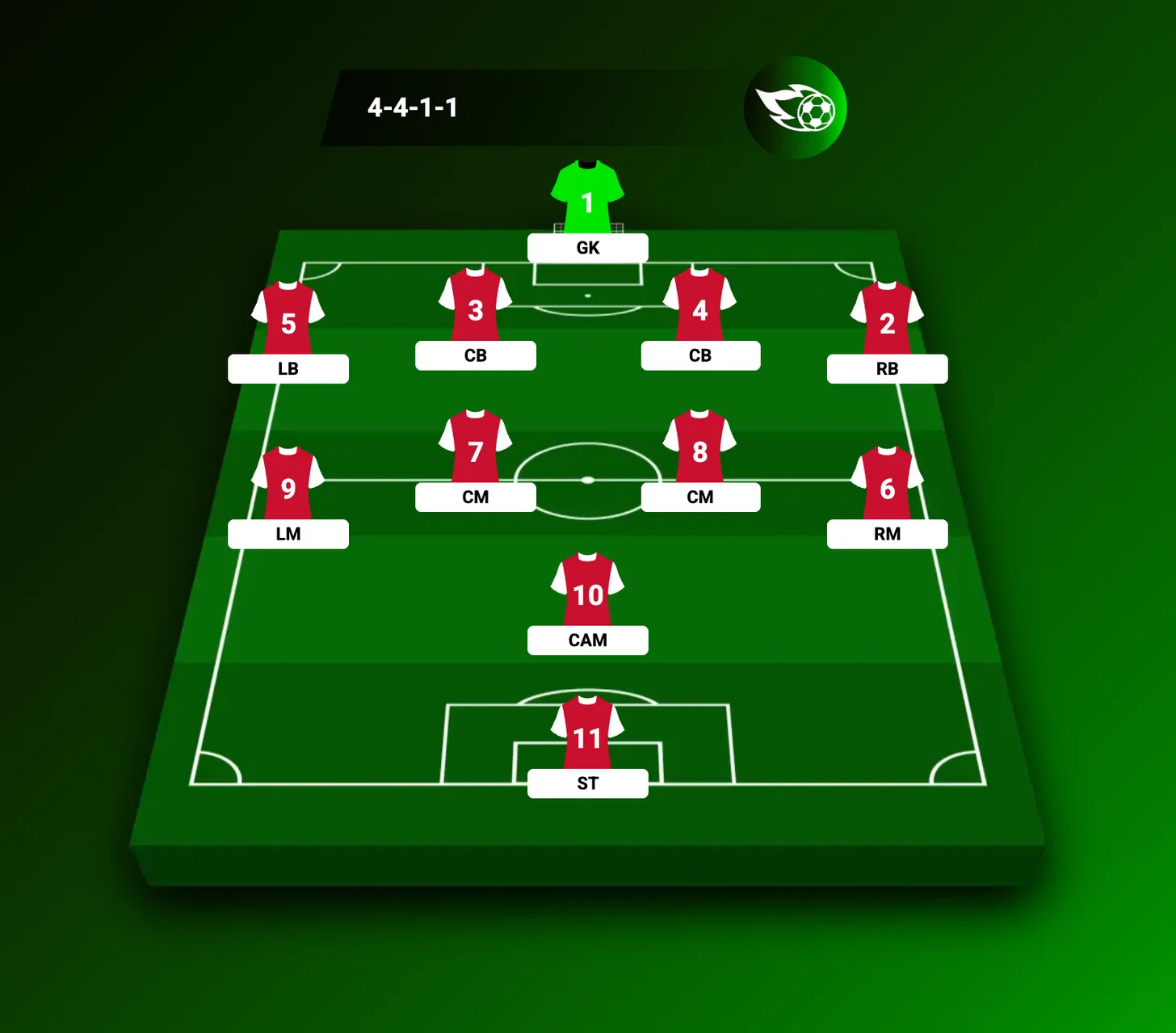 On paper the 4-4-1-1 is a 4-4-2. The difference is that the two forwards never stand level: one plays on the last defender, the other sits five to ten yards behind him in the pocket between the opposition's midfield and defence. That small stagger changes how the team presses, how it builds, and who controls the middle of the pitch. If you have ever watched a side that seems to have two strikers who are never in the same line, this is what you were looking at.
History
The shape grew out of the flat 4-4-2 that dominated English and European football through the 1980s and 1990s. Coaches looking for more central control without giving up defensive shape started dropping one striker a few yards deeper, which bought an extra body between the lines without committing to the three-central-midfielder structure of a 4-2-3-1 or 4-3-3.
By the late 1990s and 2000s it had become a pragmatic, counter-attacking shape, favoured by national teams and mid-table clubs that wanted a solid middle third and a direct out-ball to a target man. International tournaments are where it showed up most, because squads with a fortnight of training time prefer defined roles to fluid ones.
The four lines
Two centre-backs and two full-backs in a conventional back four. Two central midfielders and two wide midfielders across the middle. A support striker, the shadow striker, just behind the front man. And a lone striker on the last line.
The stagger is the point. In a flat 4-4-2 both forwards occupy roughly the same vertical zone. Here the deeper one drops into the space between the opposition's midfield and defence, which gives the team an auxiliary playmaker without removing anybody from the midfield four. Diego Simeone's Atlético Madrid and a long list of international sides have used it exactly this way.
How it works
The back four defends zonally. Centre-backs handle the aerial duels and the physical contest with the opposing striker; full-backs cover the width and provide the main route out in build-up, since neither forward drops deep enough to offer a short option.
The two central midfielders carry a heavy defensive load, screening the back four and winning the ball before it reaches dangerous areas. Claude Makélélé's positional discipline at Chelsea is the reference for what that job looks like done properly. Either side of them, the wide midfielders track back to help the full-backs while also supplying the width that the shadow striker gives up by drifting inside.
The shadow striker is the specialised role, and everything creative runs through it. Playing in the gap between the opposition's lines, this player links build-up to attack, drops deep to receive under less pressure, and arrives late into the box. Wayne Rooney played it for England at the 2010 World Cup, dropping off the front rather than staying pinned to the last defender.
Ahead of him the lone striker stretches the defence, wins aerial duels, holds up long balls and finishes what the shadow striker creates. Emile Heskey, who partnered Rooney, is the archetype: a forward whose job is to occupy centre-backs and manufacture space rather than to top the scoring charts.
Advantages
Central compactness is the first. Four midfielders sitting close together with a forward dropping in to help makes the middle very hard to play through, which is what you want against a possession side that builds centrally.
Clarity is the second, and it matters more than it sounds: every player has one defined job, nobody has to interpret a rotation or read a pattern, so the shape can be installed in a few sessions, which is why national teams with almost no training time keep reaching for it. The counter-attack is third, and it comes free with the personnel, since a physical striker to aim at plus a shadow striker arriving behind him is a fast out-ball for a team that expects to spend most of the match defending.
And it converts. Win the ball, push the deeper forward up, and it is a flat 4-4-2.
Disadvantages
The lone striker gets isolated whenever the link breaks. If the shadow striker is crowded out, the front man is alone against two centre-backs with nothing arriving, which is exactly what happened to England in 2010 when Rooney and Heskey never connected.
Wide areas are the second problem. Push the wide midfielders too deep to help the full-backs and the team loses its width entirely, and an opponent with overlapping full-backs turns each flank into a two-against-one.
In the middle, two central midfielders against three are outnumbered, and against a 4-3-3 or a 3-5-2 that usually means losing both territory and tempo.
The last weakness is concentrated in one player. The whole attack depends on the shadow striker finding pockets of space, so man-marking him out of the game removes the team's only creative route.
How opponents beat it
Overload the flanks. One extra attacker against the single wide midfielder on that side forces him to choose between tracking back and holding width, and he cannot do both.
Attack the space the shadow striker leaves. Sending a central or attacking midfielder into the pocket behind the front two drags the defensive midfielders out of position and opens the middle.
Press the two central midfielders hard. Neither forward drops deep enough to offer a short outlet, so aggressive pressure on the pivot leaves the goalkeeper and centre-backs with nothing but the long ball, and an organised back line wins those comfortably. Do it for twenty minutes and the team stops trying to play out at all, which is usually the point.
When teams pick it
Against possession-dominant opponents, where the compact midfield four is the obstacle. In tournament football, where preparation time is short and defined roles beat fluid ones. When a squad has one standout creator and one genuine target man, because the two roles were built for that pairing. And for counter-attacking underdogs who expect to spend most of the match without the ball.
Real-world examples
Fabio Capello's England at the 2010 World Cup played a 4-4-1-1 with Rooney behind Heskey. The plan was for Rooney, England's most creative attacker, to roam between the lines while Heskey's presence occupied the centre-backs. The group stage was underwhelming and the pairing never clicked, but the selection shows how international sides use the shadow-striker structure to build a team around one attacking talent. The England lineup builder has the current squad if you want to pick your own shadow striker.
Simeone has used it at Atlético Madrid as a variant of his 4-4-2, dropping one forward into a support role to add central control while leaving the defensive shape untouched. It fits the wider Cholismo idea of defending in banks of four, frustrating better teams and striking on the counter.
Spotting it while watching
Watch the vertical spacing of the front two. One forward consistently five to ten yards deeper than the other, rather than running level, is the shadow striker role.
Then watch where that player receives the ball: between the opposition's midfield and defence, usually turning to face goal rather than holding it up. Check whether the shape becomes a flat 4-4-2 when the team gets the ball high up the pitch. And see who contests the aerial duels, because the target-man work almost always belongs to the front striker while the deeper one stays in the build-up.
Related formations
For a broader look at every system teams use, see our full guide to every formation, or you can build your own with our lineup builder and try it out on the pitch.