Football Formations Guide: 14 Systems Explained and Compared

A formation decides how a team attacks and how it defends, and just as much, what happens in the seconds between the two. This page indexes every formation guide on Quick Lineup. Fourteen systems, grouped by the number of defenders, with a comparison table and answers to the questions we get asked most.
Each guide below covers the same ground. The basic shape and where it came from. What every position is responsible for. Strengths and weaknesses, plus how opponents usually beat it. Which kind of team it suits, and the real sides and managers who have used it. If the position names are new to you, soccer positions explained covers all eleven roles and what the shirt numbers mean. Terms like false 9, half-space or low block that come up in these guides are defined one by one in the football tactics glossary.
Comparison table
| Formation | Defenders | Midfielders | Forwards | Defining Trait |
|---|---|---|---|---|
| 3-4-2-1 | 3 | 4 | 1 | Twin "10s" feeding a lone striker with flexibility |
| 3-4-3 | 3 | 4 | 3 | Fluid attacking back three that morphs into 3-2-5 |
| 3-5-2 | 3 | 5 | 2 | Midfield overload with box-to-box wing-backs |
| 4-1-4-1 | 4 | 5 | 1 | A single pivot locking down central midfield |
| 4-2-2-2 | 4 | 4 | 2 | Brazil's "magic box," built on central improvisation |
| 4-2-3-1 | 4 | 5 | 1 | Modern football's most balanced system |
| 4-3-1-2 | 4 | 4 | 2 | Narrow shape built around a trequartista |
| 4-3-3 | 4 | 3 | 3 | Possession and width through wide forwards |
| 4-4-1-1 | 4 | 4 | 2 | Classic 4-4-2 refined with a shadow striker |
| 4-4-2 | 4 | 4 | 2 | The simplest, most widely taught classic shape |
| 4-5-1 | 4 | 5 | 1 | Defensive solidity built for fast counter-attacks |
| 5-2-3 | 5 | 2 | 3 | Rare back-five security paired with a three-man attack |
| 5-3-2 | 5 | 3 | 2 | Football's most explicitly defensive popular shape |
| 5-4-1 | 5 | 4 | 1 | The ultimate low-block, park-the-bus system |
Three-at-the-back systems
These formations use three central defenders, typically relying on wing-backs to double up on defensive and attacking duties. They aim to balance numerical superiority with width. How back threes went from an oddity to a default is its own story, told in the rise of three-man defenses.
- 3-4-2-1 Formation: a back three with a four-man midfield and twin "10s" supporting a lone striker in a flexible, adaptable system.
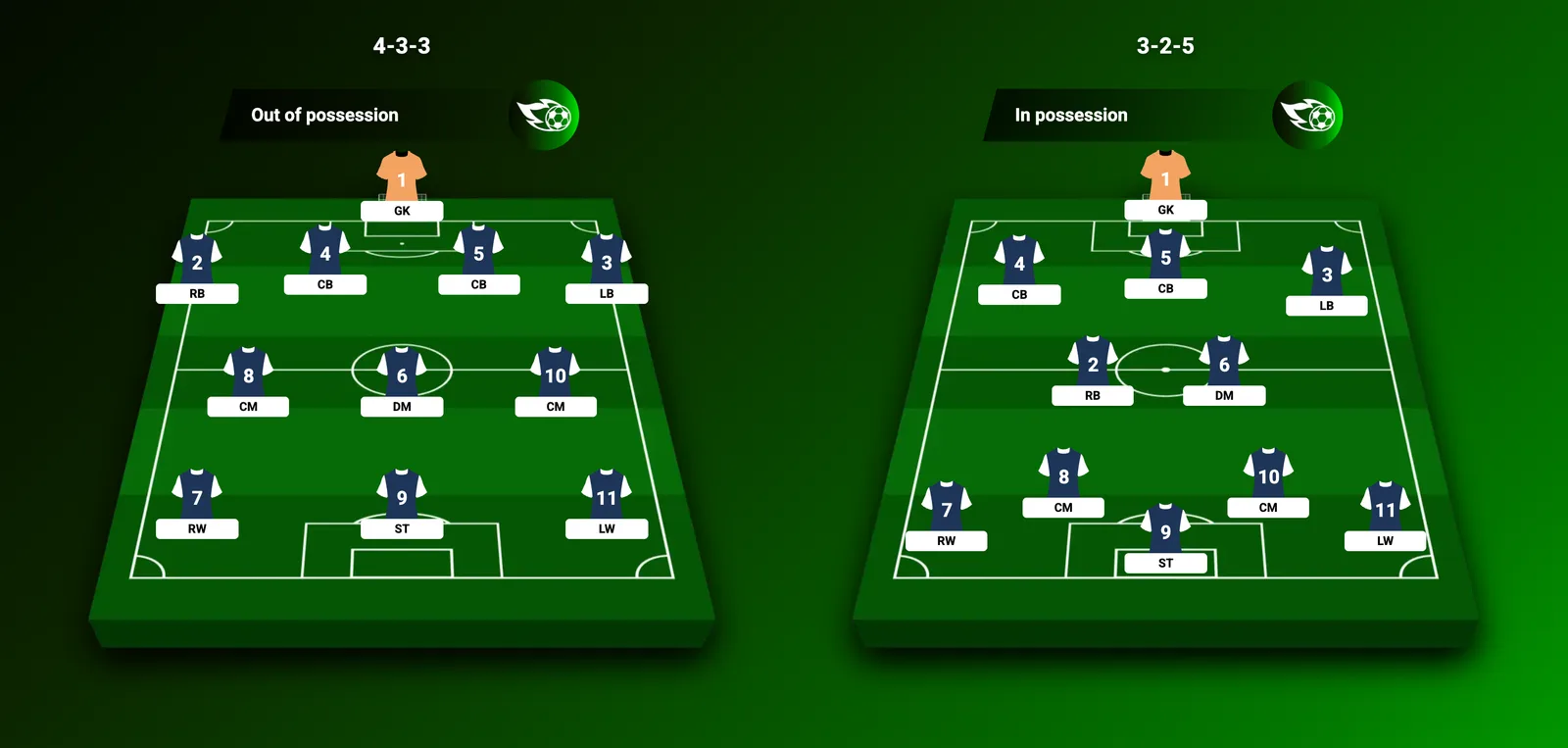
- 3-4-3 Formation: a back three combined with a front three, morphing into a 3-2-5 shape in possession thanks to constant wing-back overlaps.
- 3-5-2 Formation: three center-backs, a crowded five-man midfield, and wing-backs who cover the full length of the pitch, built for central numerical superiority.
Four-at-the-back systems
Football's most common defensive structure. Standard, easy to teach, and adaptable to dozens of midfield and attacking variations.
- 4-1-4-1 Formation: a single holding midfielder shields the back four, which frees the four ahead to press and combine higher up.
- 4-2-2-2 Formation: a Brazilian system built around a "magic box" of four central players, prioritizing improvised, fluid attacking play.
- 4-2-3-1 Formation: two defensive midfielders protect the back line while an attacking trio supports a lone striker. Modern football's most balanced system.
- 4-3-1-2 Formation: a narrow shape with a flat midfield three, a trequartista, and two strikers, prizing central density over width.
- 4-3-3 Formation: a three-man midfield feeds two wide forwards and a central striker. Possession and width with a high press, as used by Barcelona, Liverpool and Manchester City.
- 4-4-1-1 Formation: a refined take on classic 4-4-2 where the second striker drops into a "shadow striker" role to add creativity.
- 4-4-2 Formation: the classic two banks of four behind a strike partnership, simple to organize and still effective from grassroots football to the elite level.
- 4-5-1 Formation: a five-man midfield wall in front of a back four and lone striker, built for pragmatic, defense-first football and fast counter-attacks.
Five-at-the-back systems
The choice for teams prioritizing maximum defensive security, whether that means protecting a lead, frustrating a superior opponent, or building a counter-attacking game plan.
- 5-2-3 Formation: a rare system balancing back-five security with a genuine three-man attack, proven at the very highest level historically.
- 5-3-2 Formation: football's most explicitly defense-first popular shape: five defenders, a compact block, and fast counter-attacks.
- 5-4-1 Formation: football's most defensive popular system, packing nine players behind the ball to make the most of rare chances.
We keep this page up to date as new formation guides are published.
Build any formation yourself
Reading about a formation is one thing. Seeing it with your own squad is another. Head to the Quick Lineup builder to set up any of these formations with real players, customize the roles, and share the result with your team. If you are still choosing a tool, we ranked the five best free tools for making a lineup on formations, real squads and small-sided support.