How to Build the Spain National Team Lineup: A Step-by-Step Guide

Every Spain squad announcement starts the same argument: who should actually start? La Roja have the most enviable problem in world football: they produce more elite midfielders than there are places in a midfield, and more one-on-one wingers than can fit on a pitch. Arguing about it is fun. Seeing it drawn out on a pitch is something else entirely.
This guide walks through how to build the Spain national team lineup step by step: which formation to choose, how to balance the side, which selection dilemmas you'll run into, and how to download and share your XI using the Spain lineup builder on QuickLineup. There's a live example XI further down that you can copy.
What "building a lineup" actually means
Building a lineup means picking eleven players from the squad and giving each of them a specific job inside a system. It isn't a list of names, it's a structure. Every player you place defines the space he leaves next to him, who covers it when he pushes forward, and who balances the team the moment possession is lost.
That's why a lineup is always three linked decisions:
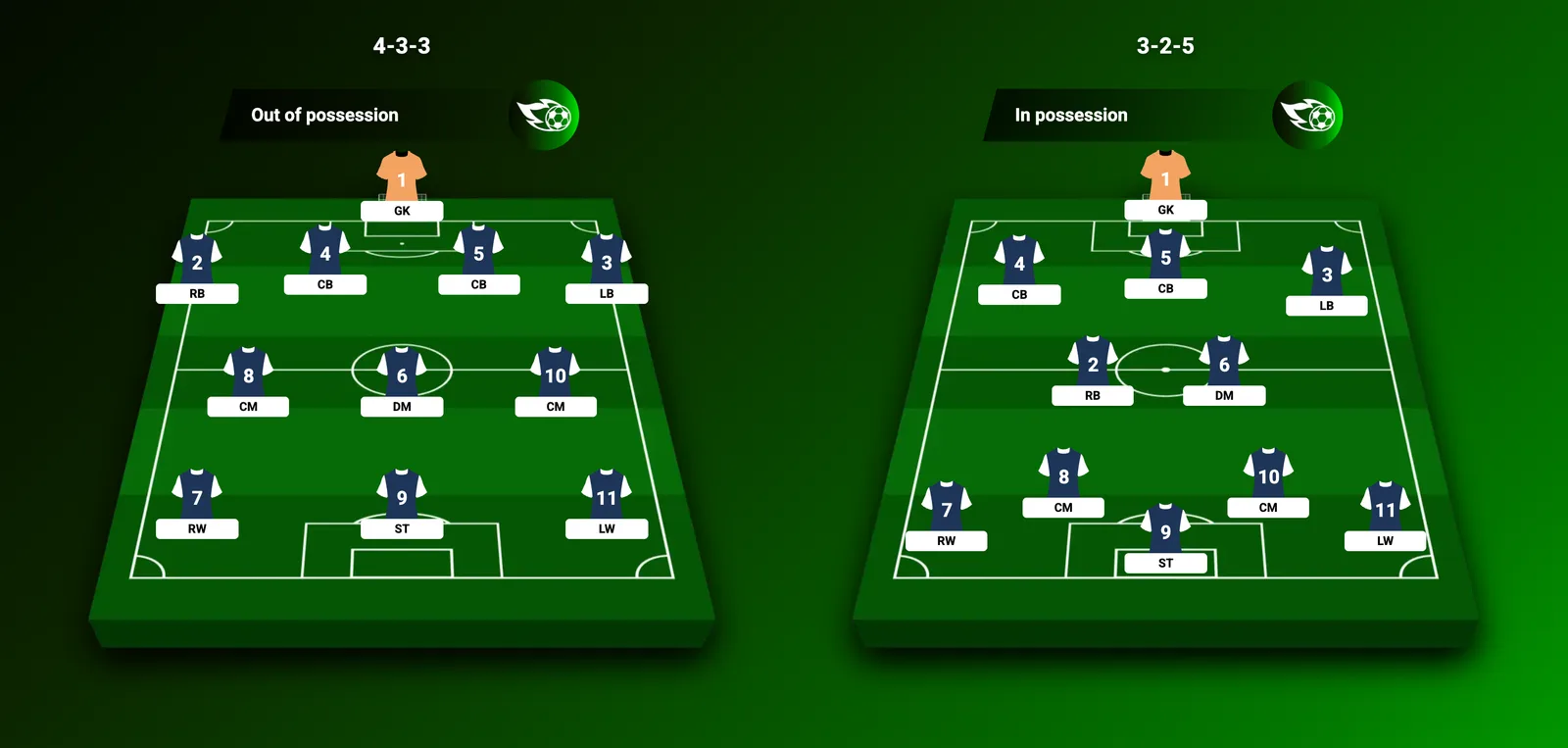
- The formation. How the ten outfield players are split into lines (4-3-3 means four defenders, three midfielders, three forwards).
- The profiles. What type of player fills each slot: a positional holding midfielder or a ball-carrier, a dribbling winger or a combination player.
- The balance. Making sure those eleven decisions don't leave the team exposed down one flank, short in build-up, or with nobody attacking the box.
International football adds a fourth constraint that clubs don't have: you can't sign anyone. You work with the players who are called up. That's exactly what makes the puzzle interesting.
How to build a Spain XI in 5 steps
1. Open the Spain lineup builder
Head to the Spain lineup builder. The page is in Spanish, but placing players works the same in any language. You'll get a pitch ready to work on plus the current La Roja squad list, with each player's position, club, age and market value. No sign-up, no install.
2. Choose your formation
Before placing anyone, decide the system. It's the decision that shapes everything else: the formation determines where the free space will be and how many players you'll have inside and outside. You can switch it at any time and watch the same players rearrange into a different shape, the fastest way to compare plans.
3. Place your eleven players
Work from goalkeeper to striker. Add the player you want in each position, then drag him to fine-tune his exact spot on the pitch: a full-back pushed higher, an interior closer to the box, a winger held wider. Those small adjustments are what turn a list of names into an idea of how you want to play.
4. Check the balance
Step back and look at the whole thing. Ask four concrete questions:
- Who holds? If there's no clear anchor staying behind when the team attacks, the XI is exposed on the counter.
- Who provides width? If both wingers cut inside, someone has to overlap outside, usually the full-backs.
- Who attacks the box? All the talent between the lines is wasted if nobody is there to finish the cross.
- Can you defend the space behind? A high defensive line needs quick centre-backs or a goalkeeper who sweeps.
If any answer isn't obvious, swap one piece and look again. That's where a lineup actually gets built.
5. Download and share
Once you're happy, download the XI as an image in one tap and post it on X, Instagram or your group chat. You can also save it and keep the permanent link to embed it in your blog later.
An example Spain XI (ready to copy)
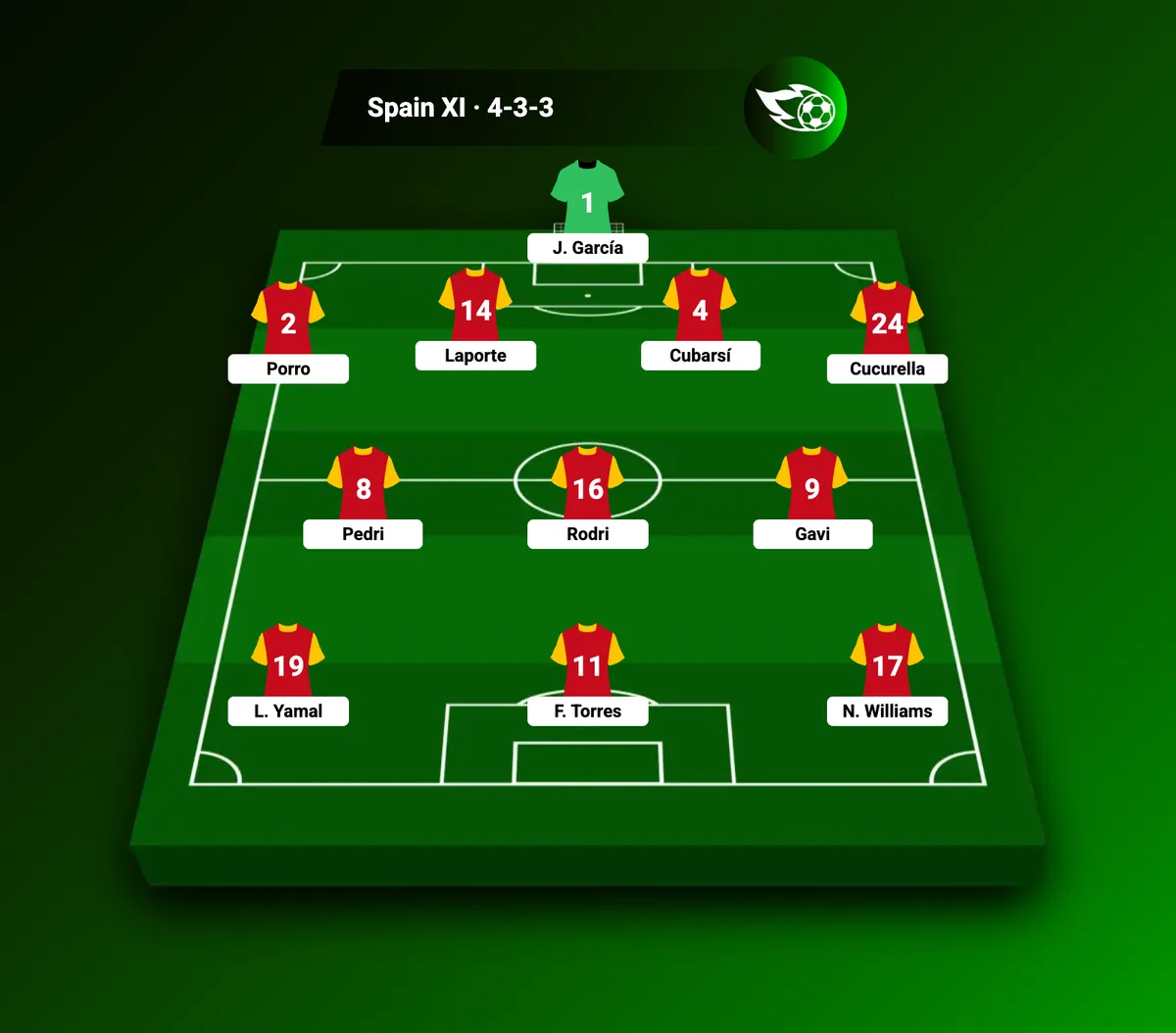
Here's a La Roja XI in a 4-3-3, put together in QuickLineup in under three minutes. It's interactive, so take a look, then build your own and change whatever you disagree with.
Lineup made with the Spain lineup builder on QuickLineup
The reasoning behind each pick:
| Position | Player | Why he's there |
|---|---|---|
| Goalkeeper | Joan García | Sharp reflexes and comfortable with the ball, which lets the team play out under pressure behind a high line. |
| Right-back | Pedro Porro | Delivers the crosses and box arrivals the inverted wingers don't provide. |
| Centre-back | Pau Cubarsí | Clean progression and early reading, so the team can defend far from its own goal. |
| Centre-back | Aymeric Laporte | A natural left-footer who opens the pitch in build-up and adds experience to the pairing. |
| Left-back | Marc Cucurella | Defensive intensity on the side of the most attacking winger in the team. |
| Left interior | Gavi | Instant counter-pressing and vertical carrying, the one who breaks a low block open. |
| Holding midfielder | Rodri | The organiser: shields the back line, sets the tempo and kills opposition transitions. |
| Right interior | Pedri | The interpreter: finds the inside pass that unlocks a packed defence. |
| Right winger | Lamine Yamal | Relentless one-on-one threat, cutting inside to shoot with his left foot. |
| Left winger | Nico Williams | Pure depth and pace, forcing the opposition back line to drop. |
| Centre-forward | Ferran Torres | A mobile nine who attacks the space in behind and opens channels for the wingers. |
This XI answers all four questions from step 4: Rodri holds, the wingers provide width, Ferran Torres attacks the box, and Cubarsí covers the space behind the defence. The criteria matter more than the names, swap the players and the reasoning still works.
Which formation suits Spain best?
Spain's best sides have always played possession systems with real width. These are the three most sensible options when building your XI:
| Formation | Core idea | Best if you want… |
|---|---|---|
| 4-3-3 | A holding midfielder, two interiors and two wide forwards pinning the full-backs. | La Roja's classic system: ball control with maximum width. |
| 4-2-3-1 | A double pivot to secure build-up and a number ten between the lines. | More protection when possession is lost, without giving up a pure creator. |
| 3-4-3 | Three centre-backs, long wing-backs and a front three. | An extra man in build-up against sides that press high. |
If you want to understand the logic of each system before deciding, the football formations guide compares fourteen shapes with their strengths and weaknesses.
The five dilemmas every Spain manager faces
Sit down to build the XI and you'll hit exactly the problems the actual manager has. None of them has a correct answer, choosing is the whole point.
- The midfield traffic jam. Spain produce more world-class midfielders than there are places. Someone elite is always left out.
- The number nine. A target striker who pins the centre-backs, or a false nine who drops in and opens the space for the wingers to run into? It changes the entire attack.
- Single or double pivot. One holding midfielder gives you an extra man further forward; two protect the transition better. Decide based on what the opponent intends to do.
- Wingers: dribblers or combiners. Spain's current generation is built on pace and one-on-one duels, a clear break from the tiki-taka combination profile. Mixing one of each is a valid answer.
- Veterans and academy graduates. Integrating the young players without losing the people who've already won things. An XI made only of young talent tends to pay for it in the tense moments.
La Roja's DNA: what to look for before picking a player
Spain defined an era with the historic Euro 2008, World Cup 2010, Euro 2012 treble, built on tiki-taka and an irreplaceable generation of midfielders. Euro 2024 confirmed the handover: a more vertical Spain, with wingers who attack one-on-one and a high press after losing the ball.
That double inheritance gives you a very practical filter when choosing players:
- Technique under pressure over physicality. A Spain starter has to be able to receive with his back to goal and an opponent on him.
- At least one organiser. Without someone controlling the tempo, individual talent scatters.
- Genuine width on both flanks. You make the pitch big on the outside so you can play through the inside.
- Coordinated pressing. The first defender is the striker: pick forwards who run backwards.
Build your XI through those four filters and it will make footballing sense even if your names are completely different from everyone else's.
Not just national teams
QuickLineup isn't limited to Spain. From the homepage you can build a lineup for any club in the world with its up-to-date squad, or create a team from scratch with your own names and kit colours, which suits a Sunday league side, a five-a-side team or an all-time XI.
And if you run a football blog or website, you can embed the lineup as an interactive widget instead of uploading a screenshot. We explain it step by step in how to embed a football lineup on your website.
Frequently asked questions
How do you build the Spain national team lineup? In five steps: open the Spain lineup builder, choose a formation, place eleven players from the current squad, check the balance of the side, then download or share the result. It takes under five minutes and it's free.
What formation does Spain play? The 4-3-3 is their reference system, with a holding midfielder and wingers holding real width. The 4-2-3-1 is the usual alternative when more control is wanted through a double pivot, and the 3-4-3 shows up against high-pressing opponents.
How many players are in a Spain squad? Between 23 and 26 depending on the competition: 23 for friendlies and qualifiers, up to 26 at Euros and World Cups when the rules allow. The starting eleven for each match comes from that list.
Can I build a Spain lineup for free? Yes, the builder is completely free, needs no account or installation, and works the same on phone and desktop.
How do I share or embed my lineup? Saving a lineup gives you a permanent page with its own link. From there you can download the image for social media or copy the iframe snippet to embed the interactive XI on your blog or forum.
Now it's your turn
Arguing about La Roja's lineup is one of the great pleasures of following this team. But next time you say "I'd play someone else in midfield", don't leave it at that: draw it.
Build your Spain lineup now: pick your formation, place your eleven, download the image and put it on the table.
What's your ideal Spain XI? Build it, share it, and start the argument.