The 3-4-2-1 Formation Explained: The Christmas Tree Tactic
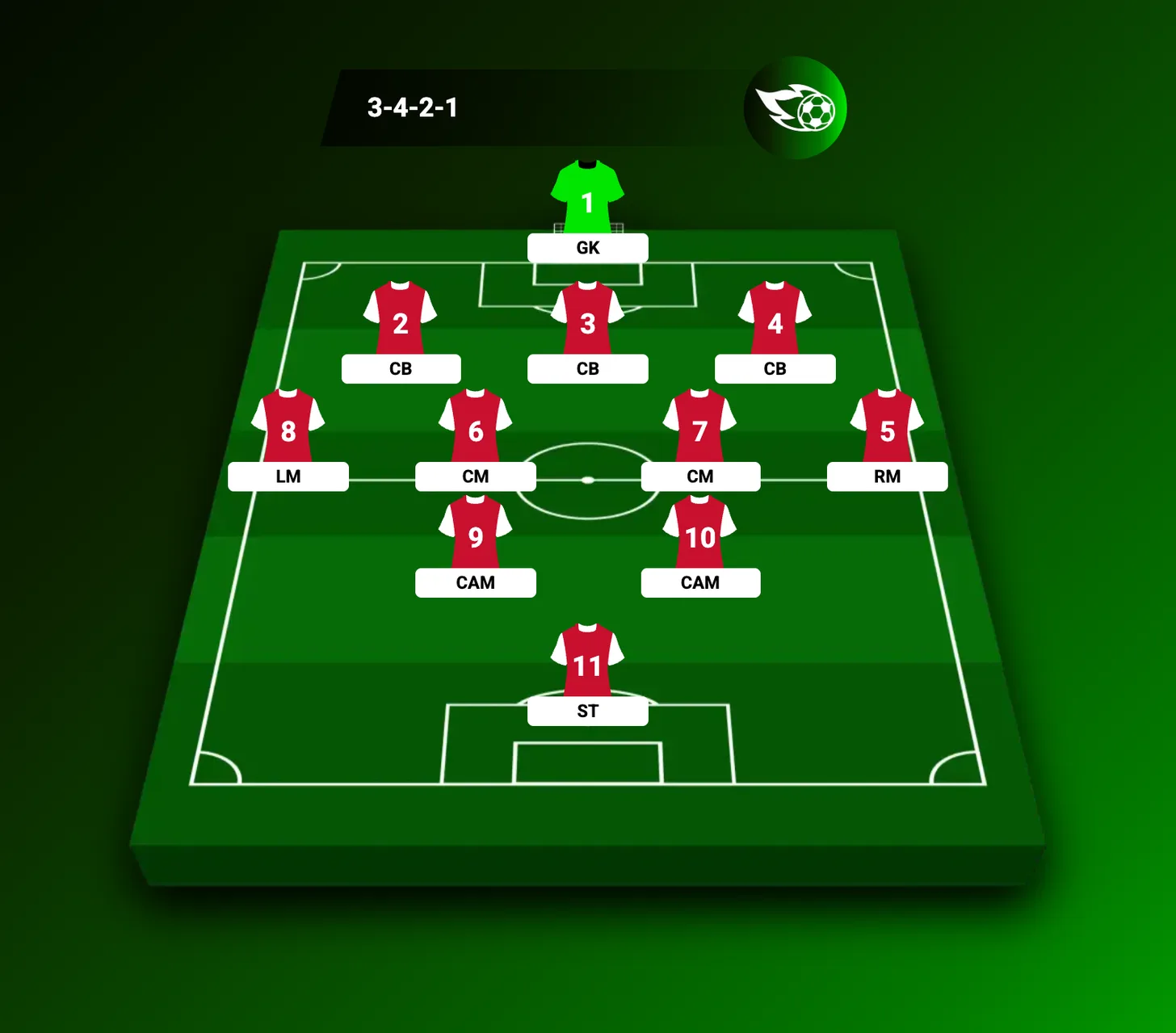
The 3-4-2-1 pairs three central defenders with a four-man midfield and two free-roaming attacking midfielders behind a lone striker. It gets called the "Christmas Tree" because the lines taper toward goal on a team sheet. Antonio Conte turned it into a Premier League title-winning system, and it has been fashionable ever since.
History
Two shapes get mixed up here constantly, so it is worth separating them.
The original Christmas Tree is a 4-3-2-1: back four, three midfielders, two No.10s, one striker. Dutch coach Co Adriaanse is credited with introducing it at Den Haag in the late 1980s. The nickname reached British football in 1994, when Terry Venables used the shape as England manager and journalists noticed the tapering lines. The 3-4-2-1 is its back-three descendant, keeping the same narrowing front but swapping a centre-back for a second wing-back.
The most successful version of the original belongs to Carlo Ancelotti, whose AC Milan won the Champions League in 2003 and 2007 with Andrea Pirlo as the deep pivot. That side played a back four. The back-three iteration found its home at Chelsea, where Conte fixed a struggling defence mid-season and proved the shape could carry a full league campaign.
What the shape looks like
Four lines that narrow toward goal. Three centre-backs: a central stopper with a ball-playing defender either side, both of whom have to cover wide zones when the wing-backs are forward. Four across the middle: two central midfielders plus two wing-backs supplying the team's entire width. Two attacking midfielders in the pockets behind the forward. One striker leading the press.
The trick is arithmetic. Three centre-backs plus two retreating wing-backs is a back five when the team defends, and the team still has three attacking players high up the pitch. Conte's Chelsea, various Inter Milan sides and Tottenham under Conte have all run versions of it.
How it works, line by line
The back three shares defensive duties with no full-backs to coordinate with, because the wing-backs cover that width. The central defender usually takes the opposition's most dangerous forward. The two either side slide across into the space their wing-back has left. All three need to be comfortable on the ball, since build-up normally starts with them splitting wide to open passing angles.
In midfield, the two central players control tempo and screen the back three, working much like a double pivot. N'Golo Kante's ball-winning alongside Nemanja Matic's positional discipline was the archetype at Chelsea in 2016-17. The wing-backs are the engine. Victor Moses and Marcos Alonso in that same side had to defend as auxiliary full-backs and then cover the length of the pitch to cross and overlap, repeatedly, for ninety minutes.
The two No.10s work the half-spaces behind the striker and swap positions to disrupt marking. One usually drops to link play while the other pushes up to support the forward directly. Eden Hazard and Pedro did this for Conte, starting wide and cutting infield to combine centrally.
That leaves the striker alone. Diego Costa's job in the title season was to hold the ball under pressure from two centre-backs, bring the No.10s into play, and finish on far less service than a forward in a front three would get.
Advantages
Defensive solidity comes from the numbers. Three centre-backs plus two deep wing-backs is a back five, and breaking that down centrally or in transition is hard.
Two creative players behind the striker is the second advantage, and the point is unpredictability rather than volume. A defence can double up on one playmaker. Doubling up on both leaves someone free.
Then there are the wing-back overloads. When both push forward at once, the team creates 4v3 and 5v4 situations against a back four, which is at its most dangerous on the counter.
The last advantage is that the shape changes without substitutions. It can become a back four or a front three depending on the phase, which is precisely how Conte rescued Chelsea's season in 2016 without changing his squad.
Disadvantages
Everything depends on wing-back fitness. A wing-back who tires or gets caught upfield leaves the back three stretched across the full width of the pitch, with a large gap in the channel behind him.
The striker gets isolated. With one out-and-out forward, service depends entirely on the No.10s finding him, and against a deep, disciplined defence he can go a long time without touching the ball.
Wide overloads are the structural weakness. One wing-back against a winger plus an overlapping full-back is a losing count, and it gets worse when neither No.10 tracks back to help.
Finally, the midfield two can be bypassed. Against a midfield three they are outnumbered in possession, which leaves the back three defending with no screen in front of it.
How opponents beat it
Attack the flank the moment a wing-back commits forward. The space behind him is covered by a centre-back who has been pulled wide of his normal zone, and that is the whole weakness in one sentence.
Pep Guardiola's Manchester City went at this directly, pushing Jesus Navas and Leroy Sane high to pin Chelsea's wing-backs deep, which freed City's own full-backs to overload central midfield. The other standard approach is to identify the less mobile of the two No.10s and press through him, since removing that outlet lets the opposition advance with less resistance.
Structurally, the counters are shapes built for width. A 4-3-3 or a 4-2-3-1 with genuine wingers can reliably create a spare man against a lone wing-back.
When teams use it
When the centre-backs are technically good enough to play out under pressure. When a squad has two No.10-type players and picking one means benching the other. When a defence is leaking and needs an extra body, which is exactly why Conte switched after the 3-0 defeat at Arsenal. And against opponents who play a lone central striker, where the third centre-back becomes a spare man on the main threat.
Two teams that made it work
Antonio Conte's Chelsea, 2016-17. Trailing 3-0 at Arsenal in September 2016, Conte went to a back three at half-time and never went back. The side settled into a 3-4-2-1 with Kante and Matic in midfield, Alonso and Moses at wing-back, Hazard and Pedro as the two No.10s, and Costa up front. Chelsea won 13 league games in a row, equalling the Premier League record Arsenal set in 2002, and finished with 30 wins from 38, the most any side had managed in a Premier League season, and 93 points, seven clear of Tottenham. The Chelsea lineup builder loads the club's current squad, so you can check who there today could play the Hazard role behind the striker.
Carlo Ancelotti's AC Milan, 2006-07, played the 4-3-2-1 rather than this formation, but it remains the benchmark for the narrowing front. Pirlo dictated from deep behind two No.10s, and Milan beat Liverpool 2-1 in the Athens final to avenge 2005 and take the club's seventh European Cup.
Spotting it while watching
Count the centre-backs first. Three players holding a defensive line with no orthodox full-backs means a back-three system, and the 3-4-2-1 is one of the most common.
Then watch the wing-backs run. The same two players defend as full-backs and attack as wingers inside a single passage of play, and their work rate is the most visible thing on the pitch.
Look for the pair behind the striker constantly swapping sides and drifting infield. And watch what happens when the team loses the ball: the two No.10s usually drop into a block of six, so the shape reads as a 5-2-2-1 or a 5-4-1 out of possession.
Related formations
Curious how it would look with your own squad? See our full guide to every formation, and you can build your own with our lineup builder and try it out on the pitch.