The 3-4-3 Formation Explained: Cruyff Tactics to Conte Title
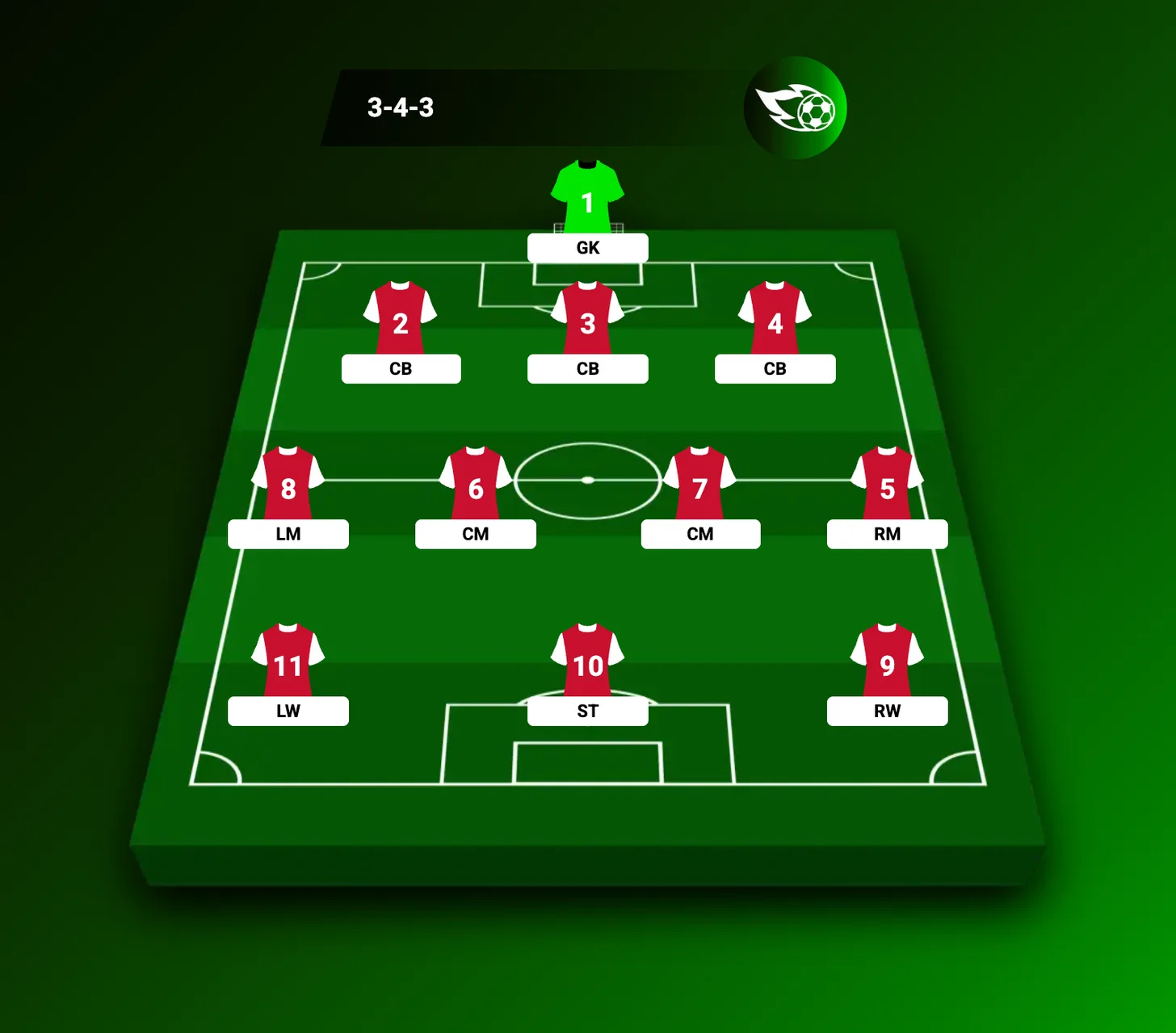 Three centre-backs, a four-man midfield, three forwards. The 3-4-3 puts five players in the final third while keeping three at the back, which is why it tends to produce goals in both directions. Johan Cruyff made it a symbol of attacking football and Antonio Conte turned it into a Premier League title, but neither version works without ball-playing defenders and wing-backs who can run all afternoon.
History
Italy adopted three centre-backs before anyone else. Serie A clubs were stockpiling central defenders through the late 1980s and early 1990s, and the back three became normal there while the rest of Europe still played fours.
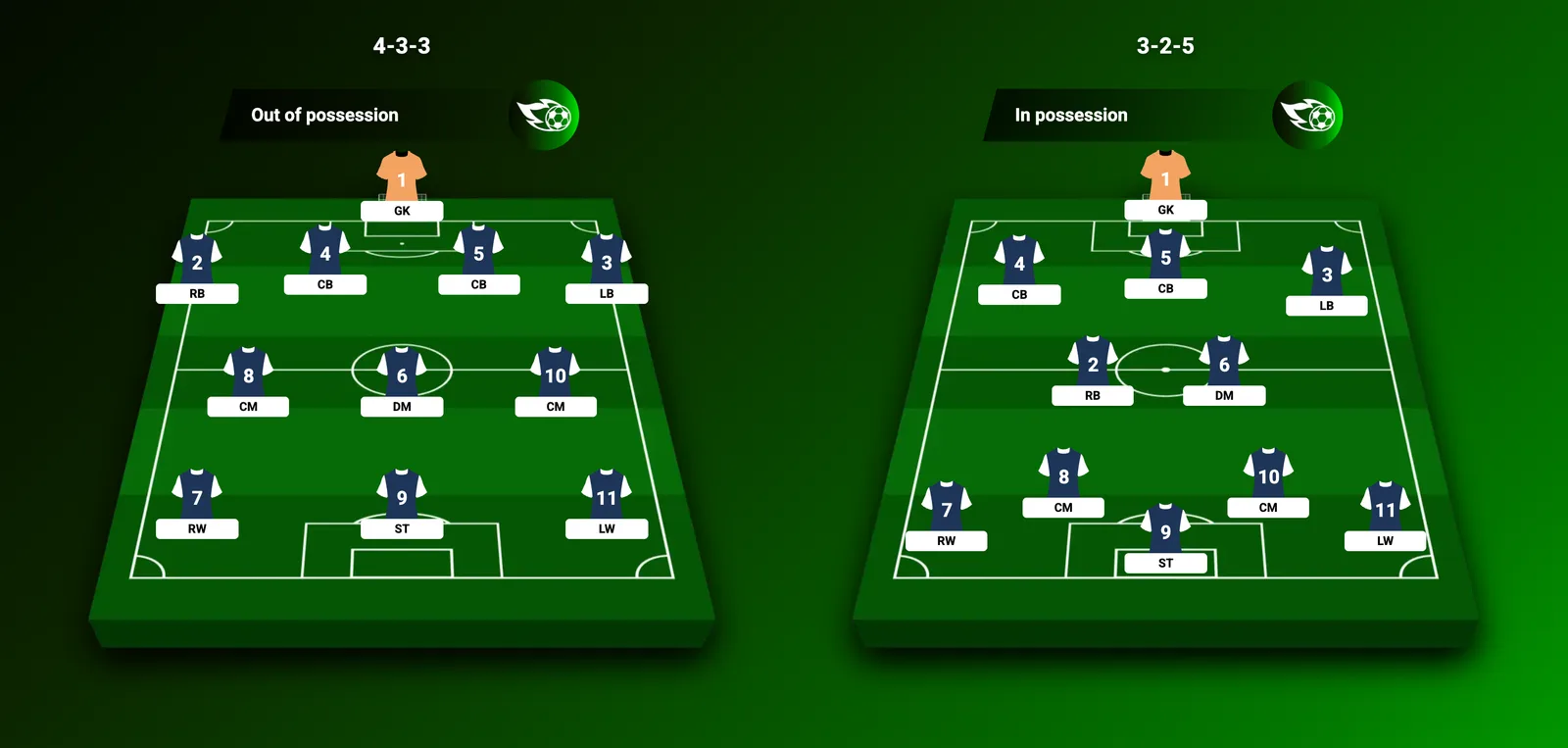
Cruyff was the one who made it attacking. His Barcelona side flipped between a 4-3-3 and a 3-4-3 with a diamond midfield depending on who had the ball, on the reasoning that a fourth defender is a wasted player who could be overloading the attack instead. He also put Pep Guardiola in a deep-lying playmaker role inside that structure, which blurred the line between defence and midfield and shaped how Guardiola would coach decades later.
Then it went quiet in England until September 2016, when Conte, under pressure after a heavy defeat, abandoned his back four mid-match and never went back to it.
The three lines
The back three is a central defender with a wide centre-back either side, and the wide two exist largely to cover for advancing wing-backs. The midfield four is two central players providing control plus two wing-backs supplying every metre of the team's width. The front three is a centre-forward with a wide attacker on each side.
That front line is the difference between this and the 3-4-2-1. Here the two players either side of the striker hold width and attack the byline. In a 3-4-2-1 they tuck into the half-spaces as inside forwards. Same eleven, different instruction. Barcelona under Cruyff, Chelsea under Conte, and a long run of Ajax and Netherlands sides have all used the wide version.
How it works
Everything starts with the back three being comfortable on the ball, because the system commits to playing out under pressure from an opposition front line. The outer two cover the space their wing-backs leave behind; the middle one organises the line and handles the opposition centre-forward.
In midfield, the double pivot screens the back three and controls the tempo. N'Golo Kante and Nemanja Matic did this for Chelsea, with Kante's ball-winning specifically covering the ground behind advancing wing-backs. Victor Moses and Marcos Alonso filled the wing-back roles in that side, a job that asks for a winger's engine and a full-back's discipline in the same player, because there is no other source of width in the shape.
Ahead of them, the front three press as a unit and rotate to unbalance defenders. Cruyff's forwards interchanged more or less constantly. Modern versions tend to use wide forwards who cut inside onto their stronger foot, with a centre-forward pinning both centre-backs so that midfield runners arrive into the space behind him.
Advantages
Wide overloads are the main one. Both wing-backs and both wide forwards committing forward creates 4v2 and 4v3 situations against a back four, and it is at its most dangerous in transition.
Pressing is the second, and it works because of the numbers rather than the effort: three forwards can close down two centre-backs and a full-back at the same time, which forces turnovers before the opponent has settled on the ball, and it happens in the opposition half where a turnover is worth most. The extra centre-back is the third advantage, letting a team double up on a lone striker and still push players forward elsewhere, a combination a back four cannot offer without leaving somebody unmarked.
Fluidity is the fourth, and it descends directly from Cruyff. When the front three and the midfield four interchange freely, opposition defenders cannot keep fixed assignments.
Disadvantages
Transitions hurt. Three defenders cover less ground than four, so a wing-back caught upfield leaves a wide channel defended by one stretched centre-back and nobody else.
Wing-back fatigue is the recurring practical problem, because covering an entire touchline for ninety minutes is not sustainable and the lapses tend to arrive in the last half hour, out wide, where they cost the most. In the middle there is a separate arithmetic problem: two central midfielders against three are outnumbered, and most matches contain spells where the ball simply travels through the centre unopposed.
Finally, the wide forwards can be stranded. If the wing-backs are not overlapping, a wide forward ends up one against a full-back and a tucked-in winger with no passing option, which is the attack breaking down before it starts.
How opponents beat it
Stretch the back three. A three-man defence cannot protect the width a back four protects, so overloading the flanks is the reliable route.
Guardiola's Manchester City tried exactly that against Conte's Chelsea, pushing Jesus Navas and Leroy Sané high to pin the wing-backs deep, which freed City's own full-backs to step into midfield and win the numbers there. It is worth noting Chelsea won that game 3-1 anyway, which says something about how well the shape held up that season.
Structurally, a flat 4-4-2 with genuine wingers or a 4-2-3-1 are the usual recommendations, because both naturally put two players against each wing-back. Pin the wing-backs and you have removed the team's only source of width.
When teams pick it
When the squad has several centre-backs who can play out from the back under pressure. When there are wing-backs with the stamina to do the job, without whom the shape collapses defensively. When a coach wants midfield security and real attacking width at once and finds the 3-4-2-1 too narrow. And against a lone striker, where the spare centre-back can mark tightly while the rest of the defence pushes up.
Two teams that made it work
Cruyff's Barcelona, from 1990-91 to 1993-94, won four straight La Liga titles and the 1992 European Cup at Wembley playing a fluid hybrid of the 3-4-3 and 4-3-3. Guardiola directed play from deep, the front line rotated constantly, and the tactical groundwork laid there shaped a generation of Spanish coaches. If you want to see how the current squad fits Cruyff's shape, the Barcelona lineup builder has every player loaded.
Conte's Chelsea in 2016-17 switched to a back three after a 3-0 defeat at Arsenal and finished the season with 30 wins from 38 matches, a Premier League record at the time, a 13-game winning run, and 93 points. Kante and Matic held the midfield, Moses and Alonso ran the flanks, and Diego Costa led the front line.
Spotting it while watching
Three centre-backs and no full-backs is the first sign, and it tells you only that you are watching a back three.
To tell a 3-4-3 from a 3-4-2-1, watch the two players either side of the striker: high and wide means 3-4-3, tucked into pockets between the lines means 3-4-2-1. After that, watch the wing-backs cover the full length of the touchline, and watch whether all three forwards press together to cut off the passes into the centre-backs. Both are 3-4-3 signatures.
Related formations
Want to see how it plays out with your own players? Check our full guide to every formation, then you can build your own with our lineup builder and try it out on the pitch.