The 3-5-2 Formation Explained: From Bilardo to Conte
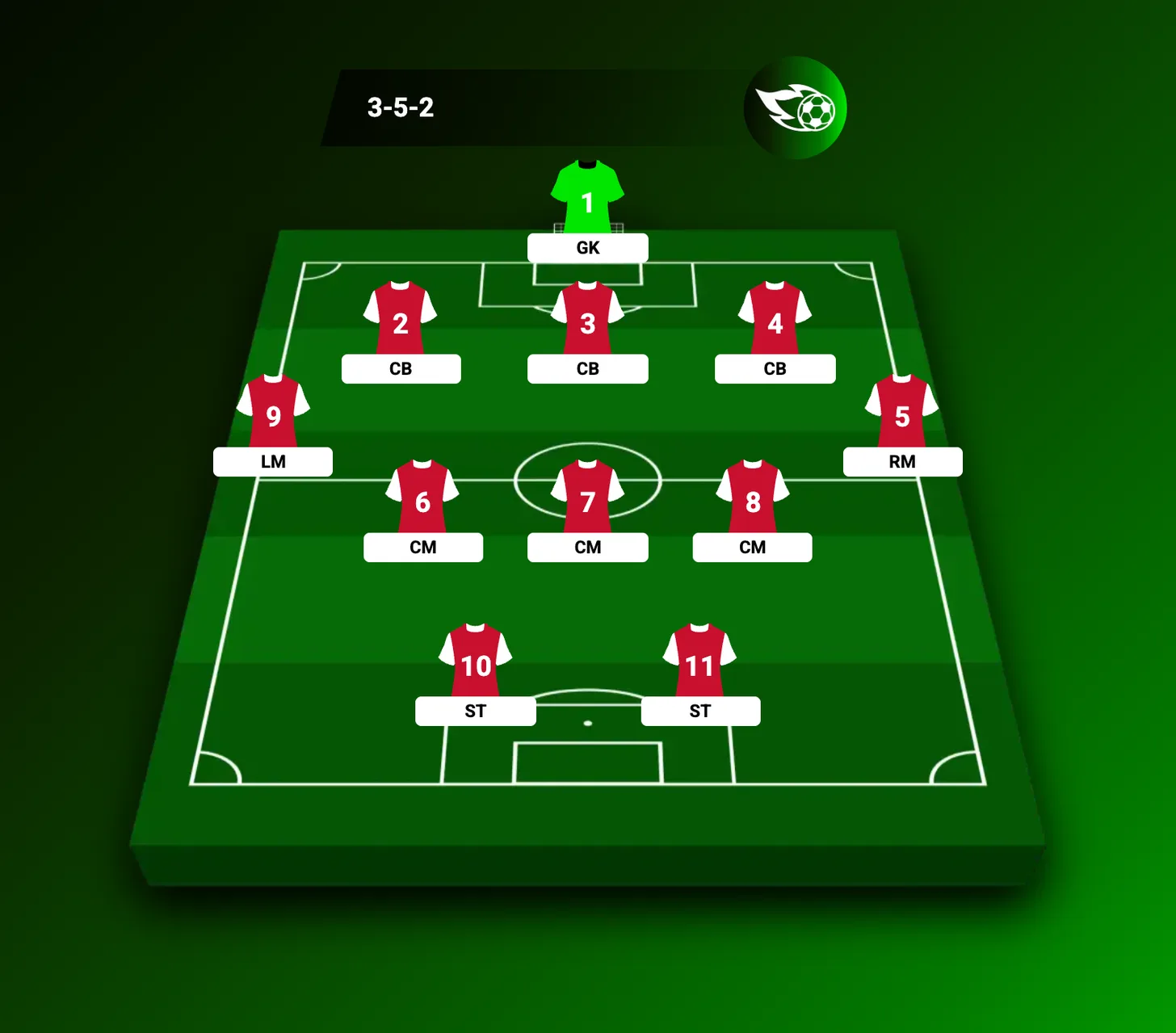 Five midfielders is the whole argument for the 3-5-2. Put that many bodies in the centre and you win the middle of the pitch against almost any back four, and you still have two strikers up front, which most modern systems have quietly given up. Three centre-backs and two wing-backs pay for it.
History
Carlos Bilardo designed the system for the 1986 World Cup with one specific player in mind. Freeing Diego Maradona from defensive work meant somebody else had to cover, and three centre-backs did. Argentina won the tournament with it.
Franz Beckenbauer, who had played libero himself, arrived at a parallel version for West Germany, built around Klaus Augenthaler sweeping behind two markers, and the idea peaked in 1990 when both World Cup finalists, Bilardo's Argentina and Beckenbauer's West Germany, lined up in variations of the same shape. That is about as complete an endorsement as a formation ever receives: two teams, two countries, two routes to the same conclusion, meeting in a final.
Italy then kept back-three systems as something close to a national identity, and the 3-5-2 has resurfaced every time a manager wants central control and defensive cover in the same team. Luciano Spalletti with the national side and Antonio Conte at Chelsea and Inter are the recent examples.
The three lines
Three centre-backs: a central defender with a wide one either side, and often a genuine libero reading play behind the line. Five midfielders: two wing-backs supplying width, plus a central three, which in practice is usually a holding player with two box-to-box midfielders either side. Two strikers, typically a target man paired with a quicker, more mobile forward.
The number that matters is five against three or four. That is the midfield overload the whole formation exists to produce, and it is why Inter under Conte, both 1990 finalists, and Spalletti's Italy could all control games without necessarily having the better players.
How it works
The back three defends centrally and, whenever a wing-back is caught upfield, out into the wide channel as well. A libero-type central defender reads danger and sweeps behind; the two either side mark forwards and step into midfield to press when the ball goes into feet.
Wing-back is the hardest job in the shape. Achraf Hakimi did it for Inter with pace and defensive discipline in the same player, which gave Conte's side control of the right flank in both directions. Inside them, the central three sets the tempo. Marcelo Brozovic screened the back three for Inter while Christian Eriksen and others carried the ball into the final third.
The front two live off that midfield. Romelu Lukaku and Lautaro Martinez interchanged constantly and ran at different angles to pull centre-backs apart, and the understanding between them is a large part of why Inter won the league.
Advantages
Central dominance is the first and the point of the whole thing. Five midfielders against four means possession and tempo belong to you by default, and it is a structural advantage rather than one you have to earn through pressing or individual quality. Defensively the spare centre-back then does two jobs at once, marking a lone striker tightly while still leaving cover for the wing-backs when they push on, which is a combination a back four cannot produce without leaving somebody free.
The strike partnership is the third advantage and the rarest. Two forwards can combine, interchange, and overload a pair of centre-backs in a way one striker never can, which is exactly what Lukaku and Martinez did to Serie A defences.
And out of possession the whole thing collapses into a 5-3-2, which is one of the hardest shapes in football to play through centrally.
Disadvantages
There are no wingers, so all attacking width comes from two players, and those same two have to cover a full flank in both directions for ninety minutes. Pin them back and the attack goes narrow and predictable; let them run and one of them will tire, leaving the space behind him open for the rest of the match. Width and stamina are one problem here, not two.
A separate gap opens vertically. When the central midfielders push forward to support the strikers, the space between them and the back three is available to a well-timed run, and there is nobody spare to fill it.
The last weakness is the count out wide. One wing-back against a winger plus an overlapping full-back is outnumbered, every time, on whichever flank the opponent chooses.
How opponents beat it
Attack the flanks, and specifically attack them the moment a wing-back has committed forward. A winger and an overlapping full-back together make it 2v1 against one defender.
The 4-2-3-1 is generally considered the best answer, because it matches the five-man midfield centrally while still fielding a full-back and winger on each side to isolate the wing-backs. Long, quick switches into the space either side of the back three work for the same reason, particularly in transition when a wing-back has stepped up to press.
The third target is vertical. Whenever the central midfielders advance to support the front two, a gap opens in front of the back three, and nobody is spare to fill it.
When teams pick it
When a manager needs to win the middle of the pitch against a possession side. When two strikers both deserve to start and benching one for a winger feels wasteful. When the squad actually contains two wing-backs with the engine for it, without which both the width and the defensive cover fail. And when the plan is to defend deep and grind out a result, since the shape compresses into a back five so cleanly.
Two teams that made it work
Bilardo's Argentina at the 1986 World Cup built the shape around Maradona, releasing him from tracking back so he could roam behind the strikers. Argentina won the tournament, and Maradona's quarter-final against England remains one of the most celebrated individual performances in World Cup history.
Conte's Inter took the 2020-21 Scudetto, the club's first league title in 11 years, with Brozovic anchoring, Hakimi supplying the width and Lukaku and Martinez up front. They finished with 28 wins from 38, 89 goals scored and 35 conceded, the best defensive record in Serie A. Lukaku's 24 league goals made him the division's second-highest scorer behind Cristiano Ronaldo's 29, with Martinez adding 17.
Today's Inter squad is loaded in the Inter Milan lineup builder, which is the quickest way to see who would take Hakimi's wing-back role now.
Spotting it while watching
Three centre-backs and no full-backs tells you it is a back three. Two strikers narrows it further.
The remaining candidates are the 3-5-2 and its close relative the 3-4-2-1, and the way to separate them is to watch the wing-backs run box to box and then count the bodies in the middle. Five players clustered centrally, squeezing the passing lanes, is the 3-5-2.
Related formations
- 3-4-2-1 Formation
- 3-4-3 Formation
- 4-3-1-2 Formation
- 4-2-3-1 Formation
- The rise of three-man defenses
Want to test the two-striker system for yourself? See our full guide to every formation, then you can build your own with our lineup builder and try it out on the pitch.