The 4-2-2-2 Formation Explained: Brazil's Magic Box
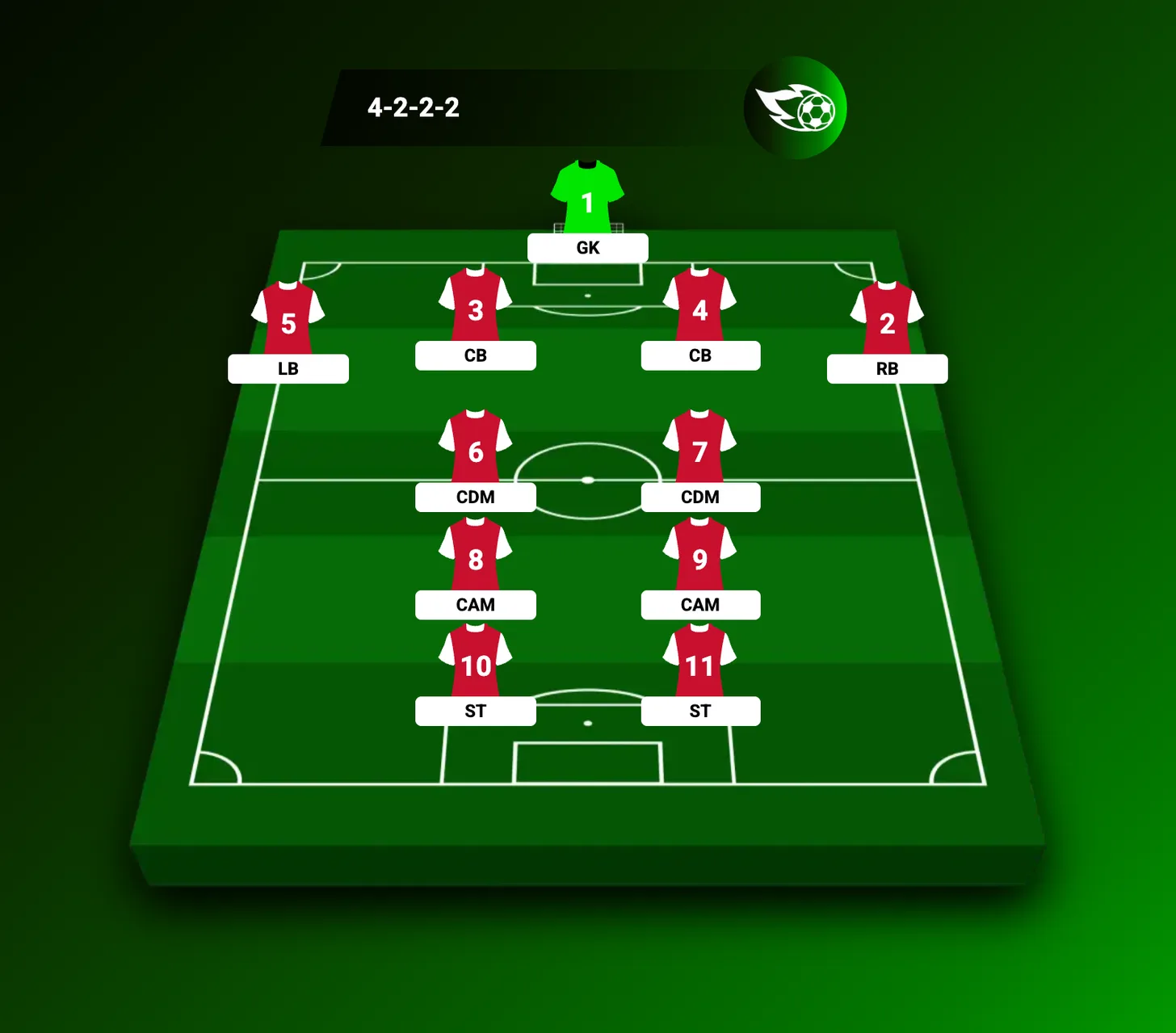 Count the wingers in a 4-2-2-2 and you get none. Two central midfielders, two attacking midfielders and two strikers are all stacked through the middle of the pitch, which leaves the full-backs as the only players who ever touch the touchline. That is the whole design: combination play in a tight central column instead of width. Brazil called the resulting shape the magic box.
Where it came from
Flávio Costa was experimenting with the idea in 1950s Brazil, building a loose, improvisational attack that valued short central combinations over crossing. It reached Europe quickly. Albert Batteux used the same central-overload principle at Stade de Reims in the 1950s and Saint-Étienne in the 1960s and won eight Ligue 1 titles doing it, still the most by any manager in French football. France then won Euro 1984 under Michel Hidalgo with Michel Platini working inside the box.
Back in Brazil the shape became a national-team habit. Telê Santana, Carlos Alberto Parreira and Vanderlei Luxemburgo all used versions of it, and Brazil were still lining up in one for the 1998 World Cup final.
Its second life came in Germany. Ralf Rangnick and Ralph Hasenhüttl rebuilt the formation at RB Leipzig, keeping the central density but attaching it to aggressive gegenpressing, which turned an attacking idea into a defensive one.
Reading the four bands
Four defenders, two centre-backs and two full-backs. Two central midfielders forming a double pivot. Two attacking midfielders, usually described as support strikers. Two forwards.
Outside the two centre-backs, every outfield player is stacked centrally. That is unusual enough to be the formation's identifying feature, and everything good and bad about the 4-2-2-2 follows from it.
How the bands interact
Centre-backs hold their central positions. Full-backs supply essentially all the team's attacking width, which is a hard ask with no winger ahead of them to combine with. When a full-back is caught upfield, a centre-back usually has to slide out and cover, because the double pivot cannot get across in time.
The two holding midfielders screen the back four and set the tempo of the build-up. The principle is the same as a 4-2-3-1's double pivot, just in a narrower structure. Ahead of them, the two support strikers drop into pockets and play one-twos with the forwards and the pivot rather than looking to switch the ball wide.
Up front, the two forwards interchange constantly to pull centre-backs out of position and combine with the attacking midfielders in very tight areas. Brazil's pairings under Santana are the classic reference. At Leipzig the same pairing worked inside a coordinated press, where the front two and the midfield four squeezed together to win the ball back immediately; Rangnick has talked about his sides recovering possession within three seconds, which is a function of how close together the shape keeps everyone.
What you gain
A central overload, first. Six players through the middle produce passing triangles and one-twos that a standard midfield cannot track man for man.
A pressing structure, second, and it comes free: the narrow shape already keeps players close together, so compressing passing lanes out of possession requires no extra work, which is precisely what Rangnick's gegenpressing at Leipzig was built on. Third, two strikers. Like the 3-5-2, this shape supports a genuine forward partnership rather than leaving one man alone against two centre-backs, and the pair can drag defenders apart for the attacking midfielders arriving behind them.
Fourth, fluidity. The two attacking midfielders and two strikers rotate freely, and Luxemburgo described the system sliding into a 3-4-3 in attack whenever a full-back pushed all the way forward.
What you give up
Width, obviously, and more of it than the diagram suggests. Attacking width depends entirely on full-backs who are usually not wide attackers by profile, so crosses and stretch play are hard to generate.
Defensively those same full-backs are overexposed, because the double pivot rarely shifts across in time and leaves them defending two against one against a winger plus an overlapping runner. Against a side with genuine wide players the whole narrow shape then has to stretch to help, and stretching it opens exactly the gaps between the lines that it normally does not have.
When a full-back is caught out, a centre-back covers the width instead. That fixes the flank and thins the middle of the defence at the same time, which is a bad trade against a well-timed central run.
How opponents attack it
They go at the flanks, because there is only one wide body per side to beat. A winger combining with an overlapping full-back creates a 2v1 in the wide channel almost at will.
A 3-5-2 or anything with genuine wing-backs is the natural counter, since the extra wide player sits exactly where the 4-2-2-2 has nobody. Good coaches also tell their wingers to hold width and stay high, which stops the ball-side centre-back or central midfielder from drifting over to help, and leaves the full-back in an isolated duel he is not built to win.
Who should play it
Squads rich in technical central players and short on wingers, which is more common than it sounds. Teams looking to break a narrow low block, where quick one-twos through the middle work better than crossing. Coaches building a high-intensity press on the Rangnick model. And squads with athletic, attack-minded full-backs, since the whole width of the team depends on those two players.
Two versions in practice
Brazil's national team used variations across several eras under Santana, Parreira and Luxemburgo, playing fluid, technical attacking football out of the shape, and still deployed it as late as the 1998 World Cup final against France.
RB Leipzig under Rangnick and Hasenhüttl ran a 4-2-2-2 and 4-4-2 hybrid built on gegenpressing. Hasenhüttl managed the club from 2016 to 2018, after Rangnick had established the playing philosophy, and the compact central shape produced the fast recoveries and quick transitions that took Leipzig from the second tier to Bundesliga runners-up in their first top-flight season.
Spotting it while watching
The absence is the clue. If both flanks are occupied only by attacking full-backs, with nobody wide ahead of them, you are probably watching a 4-2-2-2.
Then look at the middle for the box itself: two holding midfielders with two attacking midfielders directly ahead of them, all four stacked centrally. Check for a genuine front two rather than a lone striker with wide support. And watch the ball, because a run of one-twos and give-and-goes through the centre is the shape doing exactly what it was designed for.
Related formations
Curious how the magic box would work with your squad? See our full guide to every formation, then you can build your own with our lineup builder and try it out on the pitch.