The 4-3-1-2 Formation Explained: The Trequartista System
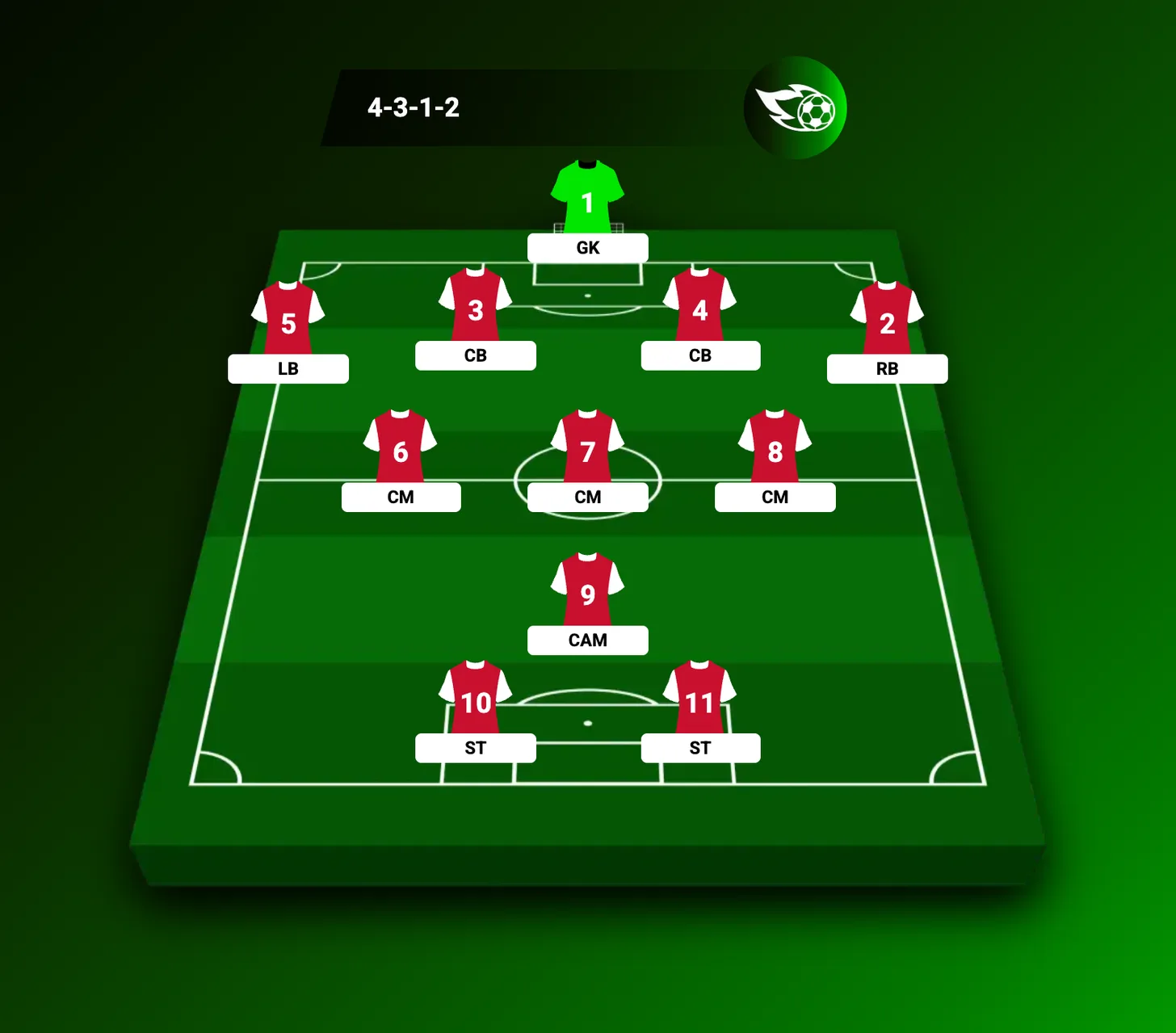
The 4-3-1-2 is a narrow, central-heavy system: four defenders, a flat midfield three, one creative playmaker in the hole, two strikers. It comes out of Italian football, and it exists for one reason, to give a trequartista a permanent home in the space between the opposition's midfield and defence.
History
Italian coaches spent decades building teams around the trequartista, the "three-quarter" player who operates in the pocket behind the opposition midfield line, the area now usually called Zone 14. The role also went by fantasista, which tells you how it was valued. Formations were designed around these players rather than the other way round, and the 4-3-1-2 was one of them.
The role nearly disappeared in the late 1980s. Arrigo Sacchi's zonal, system-first approach swept through Serie A and left little room for a player exempt from defensive work, so a generation of trequartistas reinvented themselves as second strikers or wingers to keep playing. But the shape survived. Cesare Prandelli and Carlo Ancelotti kept it and its close relatives going through the 1990s and 2000s, and Ancelotti's AC Milan turned a narrow variant into the club's signature system between 2003 and 2007. Depending on how far it tapered, the same side could be read as a 4-3-1-2, a 4-1-2-1-2, or the "Christmas Tree" 4-3-2-1. What made it work was converting Andrea Pirlo from an attacking midfielder into a deep-lying playmaker in front of the defence, which freed a genuine trequartista, Rui Costa or Rivaldo, to play in the hole.
What the shape looks like
Four narrow lines. Two centre-backs and two full-backs at the back, and because there are no wide midfielders, those full-backs supply all of the team's width. A flat central three ahead of them, balancing defensive cover against progressive passing. One attacking midfielder between that midfield line and the strikers. Two forwards.
Add those up and six outfield players occupy the middle third: three central midfielders, an attacking midfielder, and two strikers. Nothing else in football overloads the centre quite that heavily. Ancelotti and Fabio Capello both used it to win things when they had the playmaker for it.
How it works, line by line
At the back, the two centre-backs defend centrally against a front two while the full-backs are pushed high to create width. That leaves the central midfield three responsible for covering the space the full-backs vacate, because neither the trequartista nor the strikers are expected to track back.
The midfield three splits creative and defensive duties. Ancelotti's Milan is the clearest illustration: Pirlo dropping deep to build, Gennaro Gattuso supplying the energy, Clarence Seedorf running box to box. Three different jobs, one line.
Above them sits the trequartista, in the gap between the opposition's midfield and defensive lines. Francesco Totti played the role for Roma under Capello, using close control and vision to link play just off a strike partnership. Rui Costa did the same job for Ancelotti.
The two forwards work off the playmaker and off each other, running into the channels he opens. At Roma that was Gabriel Batistuta and Vincenzo Montella, with Batistuta's movement and finishing turning Totti's passes into goals.
Advantages
The formation is purpose-built for a creative number 10. It gives a technically gifted playmaker freedom from the defensive duties almost every other modern system would demand of him.
It also wins the middle of the pitch on numbers. A flat three plus a 10 is four central players before you count the strikers dropping in, which makes central progression very hard for an opponent.
Two strikers is the third advantage, and it is easy to underrate. Combination play and interchanging runs between a front two produce chances that a lone-striker system simply cannot manufacture. The 3-5-2 gets the same benefit.
Out of possession, the narrow shape is close to impossible to play through centrally. Opponents get funnelled toward the flanks, which is where the team can set its traps.
Disadvantages
Width is the obvious cost. With no wide midfielders, everything on the flanks depends on the full-backs, and if they stay conservative the team becomes one-dimensional, funnelling every attack into a congested centre.
The central midfielders pay for that. They have to cover enormous ground, and when they are pulled wide or drawn forward to support an attack, gaps open in front of the back four.
Those two problems combine into the third. A team built to dominate the centre is by definition thin out wide, so opponents who commit numbers to the flanks, whether through wing-backs or orthodox wingers, can create overloads the full-backs cannot handle alone.
How opponents beat it
They go wide, almost without exception. The plan is to build 2v1s and 3v2s on the flank, usually a winger paired with an overlapping full-back or wing-back, then cross once the defending full-back has been isolated and dragged out of position.
Two shapes are used for this more than any other. A 4-2-3-1 can match the 4-3-1-2 centrally while still fielding a winger and a full-back on each side. A 3-5-2 stretches the back four horizontally with two wing-backs. Either way the mechanism is the same: switch play early, force the central midfielders to slide across and cover, and attack the gaps that opens in front of the centre-backs. Which is, of course, exactly the kind of space the trequartista is there to exploit at the other end.
When teams use it
Three situations, mainly. When a squad has a standout playmaker who needs to be freed from defensive tracking. When two strikers have to start together and a lone-forward shape would waste one of them. And when the opponent builds through the middle, where the extra central bodies decide the fight.
There is a fourth condition that is really a prerequisite: the full-backs have to be attack-minded and disciplined enough to provide the team's only natural width without leaving the back four exposed.
Two teams that made it work
Fabio Capello's AS Roma won the 2000-01 Serie A title with a narrow system built around Totti as the trequartista, playing just behind Batistuta and Montella, with Walter Samuel anchoring the defence and Cafu and Vincent Candela providing the width. Roma finished as the league's top scorers with 68 goals and sealed the title with a 3-1 win over Parma in which Totti, Montella and Batistuta all scored. Totti was named Italian Footballer of the Year for the second year running.
Ancelotti's Milan ran their variant for four seasons. It brought the club its first Serie A title since 1998-99 in 2003-04, the 2003 Champions League on penalties against Juventus, and a second European Cup in 2007, beating Liverpool 2-1 in Athens. For the modern version, the AC Milan lineup builder has today's squad. The interesting question is who, if anyone, plays the trequartista.
Spotting it while watching
Look for one attacking midfielder in the hole with no wide partners. That single detail is usually enough.
Then check the midfield line: a flat three, not a holder with two ahead of him. Check the front: a genuine two making crossing runs off each other. And check the flanks, because if the only players you see in wide areas are the two full-backs sprinting up and down with no winger ahead of them, you are almost certainly watching a 4-3-1-2.
Related formations
Fancy building a system around your own No.10? See our full guide to every formation, then you can build your own with our lineup builder and try it out on the pitch.