The 5-2-3 Formation Explained: The Rare Attacking Back Five
The 5-2-3 is almost never played. The reason is arithmetic: keep five at the back and three up front and you are left with two men in central midfield, and two men do not hold a midfield in modern football. Every other back-five system, the 5-3-2 and the 5-4-1, spends the spare body on protection. This one spends it going forward.
Where the shape comes from
The idea is old. It echoes the 2-3-5 "pyramid" that dominated football before the offside law changed in the 1920s and pushed tactics toward more balanced, defence-first shapes. When back-five systems came back into fashion in the 1980s and 1990s, most famously through Carlos Bilardo's 3-5-2 with Argentina, most coaches spent the extra numbers on a five-man midfield. A few did the opposite and pushed them forward instead, which is how the 5-2-3 keeps reappearing.
César Luis Menotti's Argentina at the 1978 World Cup gets cited as the ancestor, but the attribution needs care. Menotti lined up in a 4-3-3, with Fillol in goal, Olguín, Galván, Passarella and Tarantini across the back, and Ardiles and Gallego in midfield. What made it look like something else was captain Daniel Passarella stepping out of central defence into the attack, which pushed the rest of the line across and produced a back-five shape in phases. Argentina beat the Netherlands 3-1 after extra time for their first World Cup.
Today the shape survives mostly in build-up structures, where a back three or five splits into a deeper and a higher line while three attackers stay high.
What the shape looks like
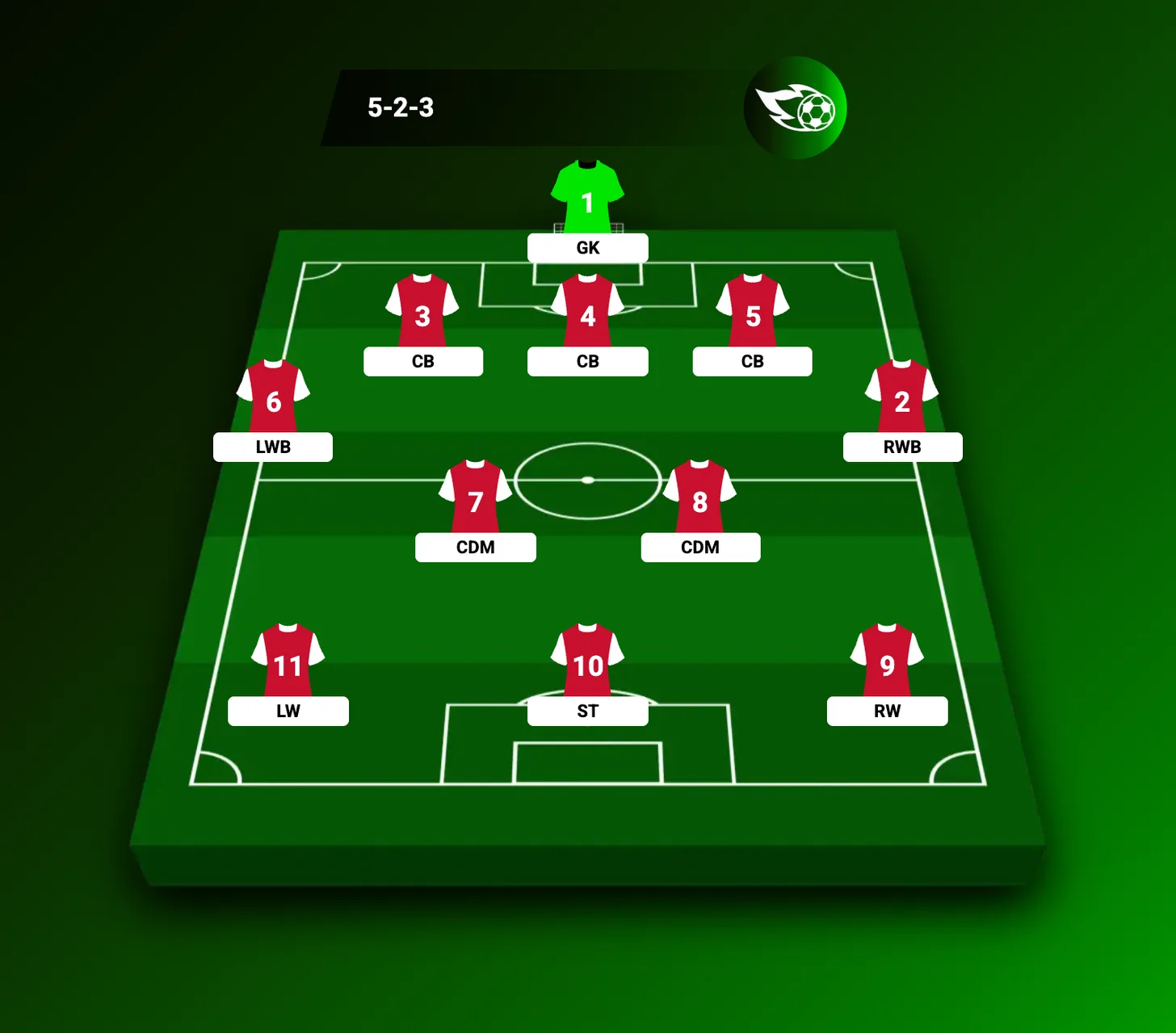
Three lines. Five defenders, three central plus two wing-backs who supply the width the front three cannot generate for itself. Two central midfielders in a double pivot, screening the back line and moving the ball into the final third. Three forwards, a centre-forward with a wide attacker either side, all staying high.
Notice what this inverts about the usual logic of a back five. A 5-3-2 or a 5-4-1 spends the extra defender on cover and packs the middle. This one spends it on freedom. The fifth defender is what lets both wing-backs push on and the centre-backs carry the ball, and three genuine attackers stay high rather than one or two.
That is the trade, and it is a steep one. Two central midfielders have to cover the entire middle of the pitch. Against a side with three there, you are outnumbered every time the ball turns over.
How it works, line by line
Two distinct roles live inside that back five. The three central defenders form a compact unit, and the middle one often plays as a ball-playing libero who steps into midfield when possession allows. The wing-backs are the system. They have to provide width in both boxes, defending against opposition wingers out of possession and overlapping the front three in attack, which is the job Achraf Hakimi does for modern back-five sides.
Everything else rests on the two in the middle. One sits deep as a pure screen, the other pushes on to link with the forwards. Ardiles and Gallego split the work exactly that way in 1978, Gallego holding, Ardiles carrying. With no third central midfielder behind them, both need positional discipline and the legs to cover for each other. One of them chasing the ball out of position is all it takes to open the middle.
Up front is where this separates itself from every other back-five system. A centre-forward leads the line with two wide attackers who stay high and stretch the pitch instead of tucking into midfield. Mario Kempes played the central role for Argentina in 1978 by dropping deep to link and then running in behind, which is roughly the profile the position needs: touch and directness in the same player.
Advantages
Real attacking numbers, first of all. Unlike the other back-five shapes, the 5-2-3 keeps three forwards engaged high up the pitch, which gives more direct goal threat and better combination play in the final third.
Second, defensive cover without giving up width. The extra centre-back is what allows both wing-backs to push forward at the same time, something a back four cannot usually do without exposing itself.
Third, presence in both penalty areas. Five defenders and three forwards is a strong set-piece squad at both ends.
And fourth, it matches up well against a lone striker, where three central defenders make it very hard for one forward to create anything alone.
Disadvantages
Central midfield is the problem, and it is a severe one. Two players covering the whole middle third are simply outnumbered against any opponent playing three there, who will take both possession and territory.
Physically, the cost lands on those same two players. Covering that much ground to defend and support the attack is unsustainable, and when the pivots tire in the last half hour the structure tends to collapse with them.
Get past those two and the counter-attack is on. There is minimal midfield cover to slow anything down, so a bypassed pivot means the back five defends a fast break with numbers against it.
One requirement is pure personnel. The system lives or dies on wing-backs who can defend one against one and still provide the attacking width. A below-par wing-back is a permanent target.
How opponents beat it
Flood central midfield. A back four with three central midfielders, a 4-3-3 or a 4-2-3-1, gives an opponent a numerical advantage in exactly the zone where the 5-2-3 is thinnest, and from there they control possession and tempo.
A second route is vertical. Quick passing into the space between the double pivot and the back five, the hole most five-man systems leave centrally, creates chances before the defence can reorganise.
Third comes the counter. Because the wing-backs push so high in possession, winning the ball and breaking fast down the flanks they have vacated gets in behind before the back five recovers its shape.
When teams use it
Against a lone striker, where the third centre-back would otherwise be wasted and the numbers are better spent going forward. When the wing-backs are among the squad's best attacking players and the whole shape is built to get them into both boxes. When a team needs to chase a result but does not want to abandon its defensive structure to do it. And when there are two genuinely disciplined, ball-covering central midfielders available, which is what makes the shape survivable across ninety minutes.
Real-world examples
César Luis Menotti's Argentina at the 1978 World Cup is the ancestor of the idea rather than a true 5-2-3. Osvaldo Ardiles and Américo Gallego held the midfield while Passarella carried the ball forward from centre-back, with Kempes, Leopoldo Luque and Óscar Ortiz attacking ahead of them. Argentina won their first World Cup with a 3-1 extra-time victory over the Netherlands, Bertoni scoring the third off the bench, and Kempes finished as the tournament's top scorer with 6 goals.
Pep Guardiola has since experimented with back-five build-up structures that split into a deeper two and a higher three, using the defensive numbers to move the ball into midfield safely while still committing width and bodies to the front line. Different era, same underlying principle.
Spotting it while watching
Count the front line first. Three players pressing high and staying advanced during defensive phases is unusual enough that it should send you straight to the back line to check for a five.
Then watch whether both wing-backs commit forward at once rather than one holding, because that simultaneous push is what the extra centre-back is there to permit.
Midfield gives the clearest tell. Two players screening the entire middle third, with visible gaps opening whenever the opposition attacks centrally. If the team looks overrun and is chasing shadows in the middle against a three-man midfield, you are watching the structural weakness of the 5-2-3 in real time.
Related formations
For a broader look at every system teams use, see our full guide to every formation, or you can build your own with our lineup builder and try it out on the pitch.