The 5-3-2 Formation Explained: Conte, Simeone, and the Modern Back Five
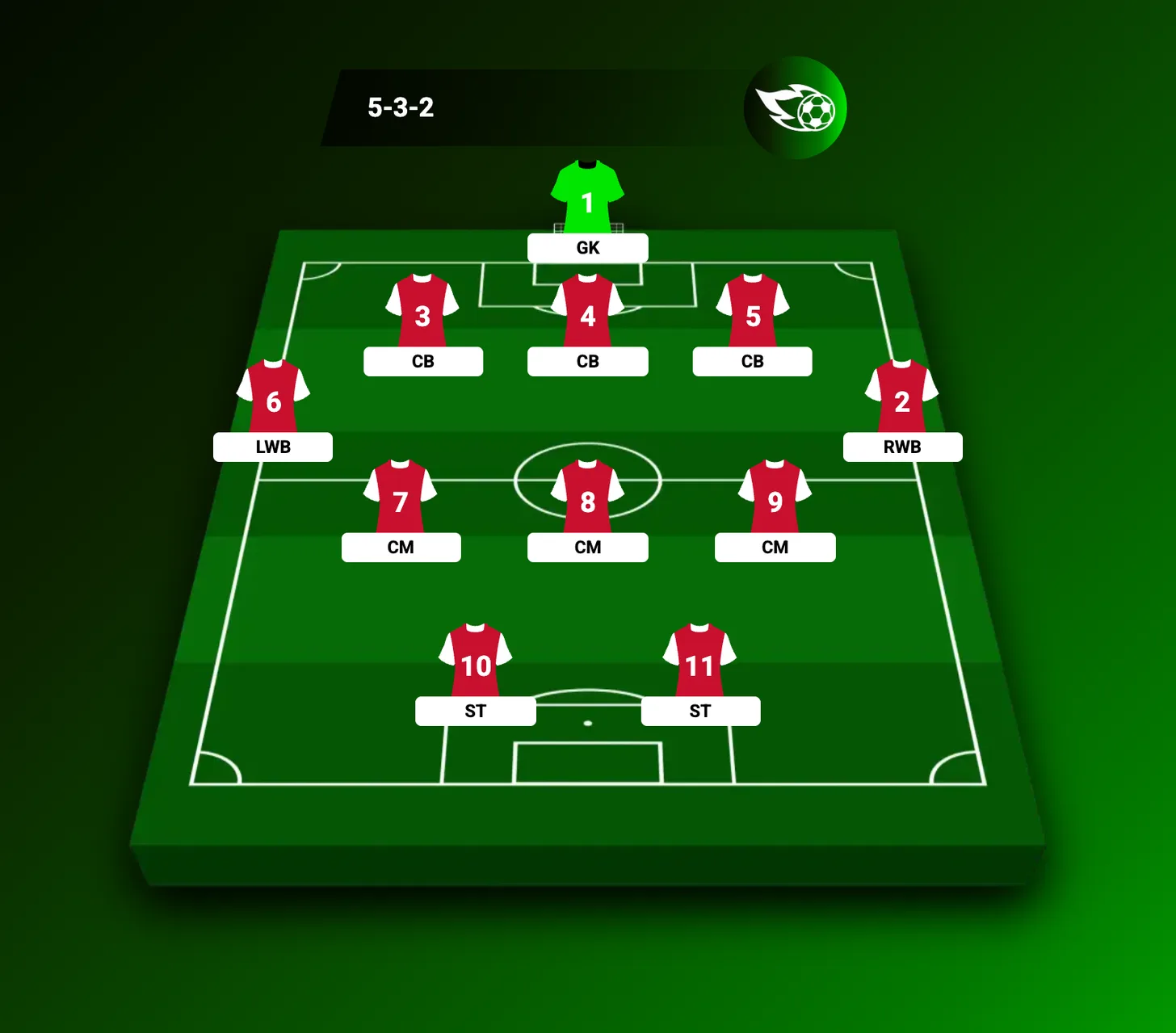 A 5-3-2 is a 3-5-2 that has decided to defend first. Same eleven players, same positions on paper, but the wing-backs sit in the back line instead of ahead of it, and everything else follows from that one instruction. The shape spent years being written off as old-fashioned before some of Europe's best coaches rebuilt it.
History
Catenaccio is the ancestor, and Helenio Herrera's Inter of the 1960s the clearest version of it: a deep libero behind a disciplined line, designed to frustrate better attacking teams. Through the 1990s, back-three systems with wing-backs became standard in Italian football, helped along by Arrigo Sacchi's influence at both club and national level, and the shape settled in as defensively secure but tactically flexible rather than merely negative.
Antonio Conte is responsible for the modern version. At Juventus first, then Chelsea and Inter, he turned the back three from a defensive device into a structure that attacks and defends equally well. His teams get labelled 3-5-2 in possession, which is accurate, and the same eleven becomes an obvious 5-3-2 the moment they lose the ball and the wing-backs drop in.
The three lines
Five defenders: three central defenders plus two wing-backs who drop into the line without the ball and push up as auxiliary wingers with it. Three midfielders: a holding player screening the defence, with two box-to-box midfielders either side. Two forwards, usually a physical target man alongside a quicker runner.
The distinction from the 3-5-2 is intent rather than personnel. Here the wing-backs are told to prioritise their defensive position and break forward selectively, which gives a genuinely secure back five instead of a back three left exposed by two advanced wing-backs. Diego Simeone's Atlético Madrid and Conte's various clubs have used the shape for exactly that discipline.
How it works
The three central defenders are the spine, and the middle one is usually the best on the ball. David Luiz played that role for Conte's Chelsea, released from man-marking duties to build in a libero style. The wing-backs are the connective tissue: in defensive phases they drop level with the back three, close down wide areas and double up on opposition wingers.
In midfield, one holding player sits in front of the five to break up play and act as the first pass out of defence, the deep-lying control Marcelo Brozović gave Conte's Inter. The two either side cover box to box, defending and supporting attacks and filling the half-spaces the wing-backs vacate on their way forward.
Up front, the two forwards split into complementary jobs. One is a hold-up striker who wins aerial duels and brings others in, the other a sharper runner attacking the space behind. Romelu Lukaku and Lautaro Martínez did precisely this for Inter, interchanging constantly to pull defenders out of position for one another.
Advantages
Defensive solidity is the first, and it holds against any attacking configuration. A back five is a spare man against a lone striker and balanced coverage against a front two, which makes the team very hard to break down through the middle either way.
Control is the second, and it is the reason the shape matches up so well against a 4-4-2: three central midfielders against two win that zone without needing to press harder or run further, they simply have the extra man. Counter-attacking is the third advantage and it comes from the security behind it, because with five defenders covering, the forwards and wing-backs can commit forward on the break without the usual risk of being caught out of position.
And the shape changes between phases without substitutions, sliding from a defensive 5-3-2 into a 3-3-4 or 3-1-4-2 once the wing-backs are up.
Disadvantages
Wing-back fatigue is the recurring cost, because covering a full flank in both directions for ninety minutes is punishing and late-match collapses in this system usually start out wide.
The front two can be isolated. Against another back three or five, two forwards are outnumbered and cut off, and the whole attacking plan comes down to whether one of them can hold the ball long enough for help to arrive.
Gaps open vertically too, whenever the central midfielders push forward to support, and a quick pass into the space between the midfield three and the back five is the standard way to punish it.
The sharpest version of the problem is a turnover with a wing-back upfield. A back four is then covering a back five's width, and the mismatch is immediate.
How opponents beat it
Play with real width. A 4-3-3 or a 4-2-3-1 with wide forwards holding the touchline pins the wing-backs deep, and a pinned wing-back turns the back five from a dynamic unit into a passive one.
Overloading one flank does the same job faster. A full-back and a winger against one wing-back is a two-against-one the structure cannot cover without pulling a centre-back out of position.
The rest of the blueprint is timing: fast switches into the space behind an advanced wing-back, and quick combinations through the gap between midfield and defence.
When teams pick it
Against opponents who dominate central midfield, where the third central midfielder is the answer to a strong pivot or trio. When the squad genuinely has two-way wing-backs, without whom the shape is only half of itself. In cautious away fixtures where staying compact and countering is the plan. And as a game-state change, since dropping into a 5-3-2 block is one of the standard ways to protect a lead.
Real-world examples
Conte's Juventus in 2011-12 built around a back three of Giorgio Chiellini, Leonardo Bonucci and Andrea Barzagli, with Andrea Pirlo, Arturo Vidal and Claudio Marchisio in midfield. Juventus went the entire 38-match Serie A season unbeaten and won the Scudetto, becoming only the third side in Italian top-flight history, and the first in a 20-team Serie A, to finish a league campaign without a defeat. To rebuild that back three with the current squad, open the Juventus lineup builder and switch the formation to 5-3-2.
Simeone's Atlético Madrid from 2023 onward is the more surprising case. Long associated with a rigid 4-4-2, Simeone moved to a hybrid that compacts into a 5-3-2 without the ball and becomes a 4-4-2 with it, switching between the two according to the game and the opponent. When a coach built on defensive rigidity starts toggling shapes mid-match, the back five has stopped being a conservative choice.
Spotting it while watching
Count the defensive line while the opponent has the ball. Five across the pitch means a 5-3-2 or something close to it.
Then judge the wing-backs. Staying near the back line rather than pushing high is what separates this from a 3-5-2, and it is a decision you can see within a few minutes. Look for two forwards rather than one, and find the single holding midfielder stationed just ahead of the three central defenders. That player is the anchor of the whole structure.
Related formations
For a broader look at every system teams use, see our full guide to every formation, or you can build your own with our lineup builder and try it out on the pitch.