Youth Football Formats by Country: Who Plays 3v3, 7v7 and 9v9 at Each Age (2026/27)
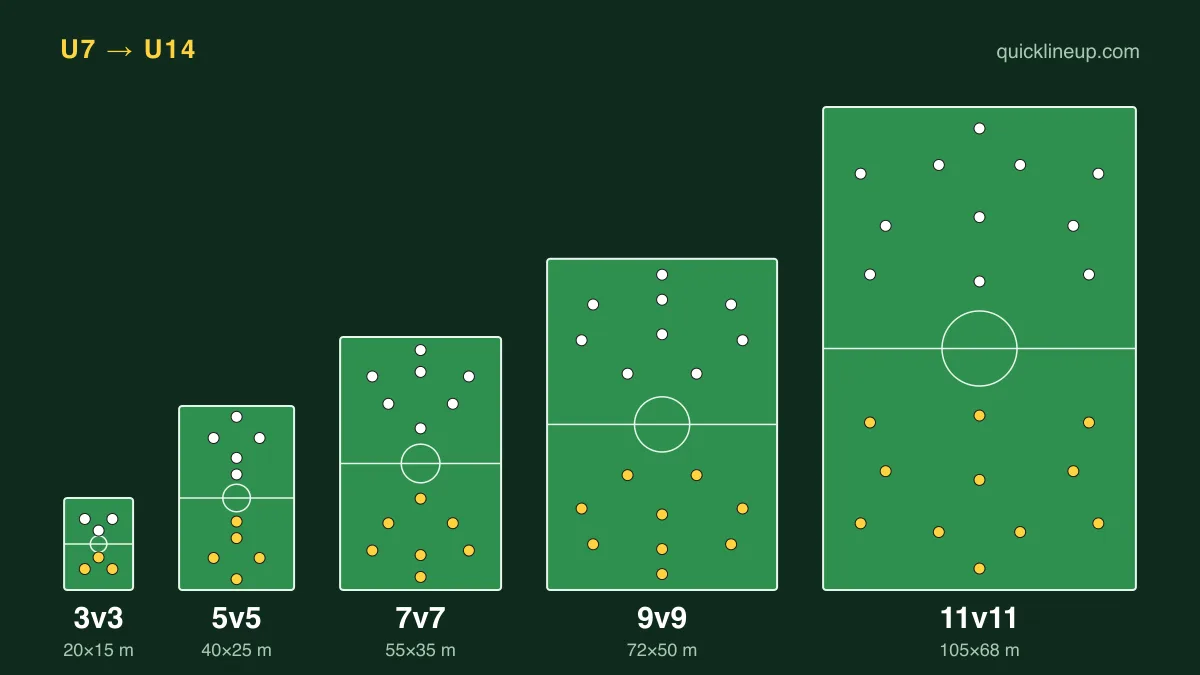
A 10-year-old plays 7v7 in England, 8v8 in France and 9v9 in São Paulo. Same age, same sport, three different games.
Every federation agrees that children should not start on a full-size pitch. They just disagree on how small to start, and when to grow. This season the gap got wider: England rebuilt its whole youth pathway for 2026/27, while Germany is in its third season of compulsory mini-goal football.
We read the rulebooks. Below are the official formats for England, Germany, France, Italy, Spain, Brazil and Turkey, with the sources at the end so you can check every number yourself.
The short answer: format by age, country by country
This is the headline table. "U10" means under-10, the season in which a child turns 10 or is still 9, depending on the country's cut-off date.
| Age | England (FA) | Germany (DFB) | France (FFF) | Italy (FIGC) | Spain (regional) |
|---|---|---|---|---|---|
| U6–U7 | 3v3 (U7) | 2v2 / 3v3, four mini goals | Foot à 3 / foot à 4 | 2v2 / 3v3 | Fútbol 7 or 8, by region |
| U8–U9 | 5v5 | 3v3 or 5v5 | Foot à 5 | 4v4 / 5v5 | Fútbol 7 or 8 |
| U10–U11 | 7v7 | 5v5 or 7v7 | Foot à 8 | 7v7 (or 5v5) | Fútbol 7 or 8 |
| U12–U13 | 9v9 | Mostly 9v9, set regionally | Foot à 8 | 9v9 (or 7v7) | 11v11 in most regions |
| U14+ | 11v11 | 11v11 | 11v11 | 11v11 | 11v11 |
Two countries are missing from the table on purpose. Brazil and Turkey have no single national children's format. We explain what they do instead further down.
England: 3v3 arrives and 11v11 waits until U14
The FA's Future Fit changes went live at the start of the 2026/27 season.
Everything shifted up a year. Under-7s now play 3v3, under-8s and under-9s play 5v5, under-10s and under-11s play 7v7, and 9v9 now covers both under-12s and under-13s. Full 11v11 starts at under-14, one year later than before.
The 3v3 game is the headline. Pitches run from 15 x 10 m to 20 x 15 m, goals are 120 x 75 cm and each game lasts 6 to 10 minutes. No goalkeepers. No referee either, just one adult facilitator per pitch, and several 3v3 games run side by side on the space of one 5v5 pitch.
| England 2026/27 | U7 | U8–U9 | U10–U11 | U12–U13 | U14+ |
|---|---|---|---|---|---|
| Format | 3v3 | 5v5 | 7v7 | 9v9 | 11v11 |
| Match length | 6–10 min | 40 min | 50 min | 60 min | 70–90 min |
| Ball | Size 3 | Size 3 | Size 3 | Size 4 | Size 5 |
| Goals | 4 x 2.5 ft | 12 x 6 ft | 12 x 6 ft | 16 x 7 ft | 21 x 7 ft / 24 x 8 ft |
Two smaller rules matter just as much on matchday. Throw-ins are gone up to under-11: players pass or dribble the ball back in. And deliberate heading is banned in matches from under-7 to under-11, punished with an indirect free kick.
The size 3 ball now stays with players until the end of under-11.
Germany: four mini goals, compulsory since 2024/25
Germany got there first. After a two-year pilot, the DFB made its new children's formats compulsory across the country from the 2024/25 season.
The youngest age group, the G-Jugend (U6/U7), plays 2v2 or 3v3 on four mini goals no bigger than 2.0 x 1.2 m. Each team defends two goals and attacks two. Pitches are around 16 x 20 m for 2v2 and 25 x 20 m for 3v3.
The F-Jugend (U8/U9) plays 3v3 on mini goals or moves up to 5v5 on a pitch of about 40 x 25 m. The E-Jugend (U10/U11) plays 5v5 or 7v7, and the 7v7 game uses small-sided goals on a pitch of about 55 x 35 m, over 4 x 15 or 2 x 25 minutes.
German games are short and frequent. A G-Jugend festival is at most seven games of 5 to 7 minutes, with players rotating in after every goal. The ball is a size 3 of 290 g until the E-Jugend, which switches to a size 4 of 350 g.
The D-Jugend (U12/U13) is left to the regional associations. Most play 9v9 on a small pitch. Lower Saxony (NFV), for example, allows 9v9 or 7v7 with 60 minutes of total playing time. If you coach in Germany, our Kleinfeld formations guide covers the shapes that work at 5+1, 6+1 and 7+1.
France: foot à 8 for four seasons
France makes one big jump and then holds still. Children play foot à 8 (7 outfield players plus a goalkeeper) from under-10 all the way to under-13.
The FFF publishes the equipment rules on its children's football page. Goals are 4 x 1.50 m for U6 to U9 and 6 x 2.10 m from U10 to U13. The ball is a size 3 of about 300 g up to U9 and a size 4 of about 400 g from U10.
Before foot à 8, the youngest play foot à 3 and foot à 4. The U6 pitch is 21 x 20 m and the U7 pitch is 28 x 20 m. Under-8s and under-9s play foot à 5 on a pitch of 35 to 40 m by 25 to 30 m. The FFF's own foot à 8 pitch is half of a full-size pitch.
Match length is set at district level, so we have left it out of the comparison.
Italy: Pulcini at 7v7, Esordienti at 9v9
Italy's youth sector (Settore Giovanile e Scolastico) uses names rather than numbers for its age groups. Piccoli Amici (U6/U7) play 2v2 and 3v3. Primi Calci (U8/U9) play 4v4 and 5v5 with a size 3 ball.
The 7v7 game belongs to the Pulcini (U10/U11): periods of 15 minutes on a pitch 50 to 65 m long, with a size 4 ball and goals of generally 4 x 2 m. A 5v5 option exists for first-year Pulcini.
Esordienti (U12/U13) play 9v9 in periods of 20 minutes, on 60 to 75 m by 40 to 50 m. First-year Esordienti may play 7v7 instead. Goals are 5.50 x 2.00 m or 6.00 x 2.00 m. At these ages Italian matches are never two halves: they are split into three or four periods, which gives the coach more chances to rotate.
These figures come from the 2025/26 FIGC handbook for coaches. The youth sector publishes its rules season by season, so check your regional committee for 2026/27 changes.
Spain: it depends on where you live
Spain has no single national children's format. The Royal Spanish Football Federation leaves it to the regional federations, and they do not agree.
Catalonia plays fútbol 7. The Catalan federation's July 2026 rules set a pitch of 50 to 65 m by 30 to 45 m, goals of 6 x 2 m, a size 4 ball and four periods per match, with the length of each period set by the competition. The Valencia region plays fútbol 8 for its prebenjamín, benjamín and alevín categories, according to the Valencian federation's competition circular.
The age categories are shared, though. Benjamín covers ages 8 and 9, and alevín covers 10 and 11. Most regions move to 11-a-side at infantil level, ages 12 and 13. Our guide to fútbol 7 formations covers the Catalan-style game.
Brazil and Turkey: no single national rulebook
In Brazil, the CBF does not set a national children's format. State federations do.
The best-documented example is São Paulo. The Paulista federation's under-11 championship is played 9v9 on a 72 x 50 m pitch, with 5.00 x 2.20 m goals and a size 4 ball. The 2023 regulation set two halves of 25 minutes with a 3-minute technical break in each. For 2026 the federation changed under-11 and under-12 games to three periods of 17 minutes.
Turkey is a different case. The TFF's national development leagues (Gelişim Ligleri) start at under-14, and they are full 11v11 with a size 5 ball and two halves of 35 minutes. Below that age, games are run as festivals by regional offices, and we could not find one national rulebook for them. For most Turkish kids, the real small-sided game is halı saha, the 6, 7 or 8-a-side pitch you book by the hour.
Same 10-year-old, six rulebooks
The clearest way to see the differences is to follow one child. Here is what a 10-year-old's matchday looks like in each country.
| Country (age group) | Format | Pitch | Ball | Goals | Match length |
|---|---|---|---|---|---|
| England (U10–U11) | 7v7 | Set by league | Size 3 | 3.66 x 1.83 m | Max 50 min |
| Germany (E-Jugend) | 7v7 or 5v5 | About 55 x 35 m | Size 4, 350 g | Small-sided goals | 4 x 15 or 2 x 25 min |
| France (U10–U11) | 8v8 | Half pitch | Size 4, about 400 g | 6 x 2.10 m | Set by district |
| Italy (Pulcini) | 7v7 | 50–65 m long | Size 4 | Generally 4 x 2 m | 15-minute periods |
| Spain, Catalonia (alevín) | 7v7 | 50–65 x 30–45 m | Size 4 | 6 x 2 m | Four periods |
| Brazil, São Paulo (U11) | 9v9 | 72 x 50 m | Size 4 | 5 x 2.20 m | 3 x 17 min (2026) |
The ball is the oddest split. An English 10-year-old still plays with a size 3; everyone else in the table has already moved to a size 4.
What the federations agree on
Strip out the details and two things line up.
Children start with tiny teams. England, Germany and Italy all put under-7s in 3v3 or smaller, often without goalkeepers. The logic is simple: fewer players means more touches per child.
Full 11v11 waits until about 14. England's move from under-13 to under-14 brought it in line with Italy, France, Germany and the Turkish development leagues.
Where they disagree is the middle. France goes straight from 5 to 8 players and stays there. England and Italy step through 5, 7 and 9. Germany offers two options in almost every age group and lets the festival decide.
Planning a lineup for these formats
Once the format is fixed, the coaching question is the same everywhere: who plays where, and who comes on after the first period. With rolling subs and equal-time rules, that sheet changes every week.
That is the part we built QuickLineup for. You can set up a 7-a-side lineup or a 9-a-side lineup, type the names and send it to the parents group as an image. For 5v5 there is a 5-a-side builder. The 3v3 game has no fixed positions at all, which is rather the point.
If you are unsure how many players each senior format uses, our guide to how many players are on a soccer team covers 11-a-side, futsal and the adult small-sided games.
Sources
Every figure above comes from these documents, checked on 2 October 2026:
- England: The FA, Know Your Format guide (February 2026), Mini-Soccer and Youth Futsal Handbook (August 2026) and A closer look at 3v3
- Germany: DFB, Kinderfußball overview and Wettbewerbsformen im Kinderfußball booklet; NFV, Jugendordnung annex (July 2026)
- France: FFF, Le foot pour les enfants and Football à 8 et à 5
- Italy: FIGC Settore Giovanile e Scolastico, Vademecum 2025/26 (Friuli Venezia Giulia)
- Spain: Federació Catalana de Futbol, Regles de joc futbol 7 (July 2026); FFCV, Circular fútbol 8 2024/25
- Brazil: Federação Paulista de Futebol, Sub-11 and Sub-13 regulation; 2026 format change report
- Turkey: TFF, Gelişim Ligleri statute 2025/26 and development league playing rules
Spotted a rule that changed in your region? Federations update these every season, and a correction from a coach on the ground is worth more than any rulebook PDF.