Futsal vs Indoor Soccer vs 5-a-Side: Rules, Positions and Formations
Five players a side, a small pitch, indoors. That description fits three different games, and mixing them up is how people turn up to a futsal league expecting to play the ball off the wall.
Only one of the three has a rulebook written by FIFA. The 2025-26 edition of the futsal laws took effect on 5 September 2025, and everything below is checked against it, FIFA's futsal coaching manual and The FA's own guidance.
Where futsal comes from
A PE teacher in Montevideo invented it. Juan Carlos Ceriani wanted children to play football on basketball courts in 1930, borrowing from basketball, water polo and handball for the pitch size, the number of players and the goalkeeper's role. The name blends the Spanish words fútbol and sala, a room.
FIFA took the game under its roof in 1985, and its coaching manual says futsal is now played in more than 170 of its 211 member associations. The first FIFA Futsal World Cup was in 1989 in the Netherlands. Brazil won it, and won the 2024 final in Tashkent too, 2-1 against Argentina, for a record sixth title.
Futsal or indoor soccer? The wall decides
Futsal is played on a hard court with touchlines, a heavier ball that barely bounces and a stopping clock. Indoor soccer is played inside walls that keep the ball alive. Here is how the two rulebooks line up, using the pro league MASL for indoor soccer because it publishes its rules in full.
| Futsal (FIFA laws 2025-26) | Indoor soccer (MASL 2025-26) | |
|---|---|---|
| Players on court | 5, including the goalkeeper | Up to 6, including the goalkeeper |
| Boundary | Touchlines; ball out means a kick-in | Perimeter wall that stays in play |
| Ball | 62-64 cm, 400-440 g, low bounce | 27-28 inches around, a regular ball |
| Goals | 3 m x 2 m | 14 ft x 8 ft (about 4.3 m x 2.4 m) |
| Pitch | 38-42 m x 20-25 m for internationals | 150-210 ft x 75-100 ft (about 46-64 m x 23-30 m) |
| Match | 2 x 20 minutes of playing time | 4 x 15 minutes, clock runs while the ball is in play |
| Substitutions | Unlimited, on the fly | Unlimited, on the fly |
Amateur indoor leagues vary. One Canadian boarded rulebook plays two 25-minute halves with 12-foot goals, so read your venue's rules before assuming anything.
English five-a-side sits closer to indoor soccer than to futsal. The FA's own futsal guide describes the traditional game as one played off rebound boards or walls, with a standard ball, no cap on fouls and a clock that never stops. Futsal's laws, it says, reward skill over the physical contact that tends to define five-a-side.
Seven rules that change how you play
- No offside. Nobody can be caught offside in futsal, so a pivot can park on the last defender's shoulder all night.
- Kick-ins, not throw-ins. The ball goes back in with the foot from the touchline, and a goal cannot be scored directly from one.
- Four seconds. Kick-ins, corners, goal clearances and free kicks must be taken within 4 seconds of the team being ready, or the opponents get the restart.
- The ceiling is live. If the ball hits the ceiling, the opponents of the last team to touch it get a kick-in.
- The keeper is on a clock. A goalkeeper cannot control the ball in their own half for more than 4 seconds, and cannot take a deliberate pass back from a team-mate a second time unless an opponent has touched the ball.
- The sixth foul hurts. Each team can commit 5 accumulated fouls per half. From the sixth, the opponents take a direct free kick, usually from the 10 m mark, with no wall, and the keeper must stay 5 m away.
- One minute to talk. Each team has one 1-minute timeout per period. A red card costs two minutes of playing time with one player fewer, and a goal by the side with more players can end it early.
The bench matters too. Up to nine substitutes can be named, and changes happen on the fly through the team's own substitution zone.
Four positions, and what FIFA calls them
Futsal's vocabulary came from Spanish and Portuguese, and it translates badly. FIFA's coaching manual says as much and standardises the English terms: goalkeeper, defender, winger and pivot. You will still hear fixo and ala in every club, because those are the Portuguese and Spanish names the game grew up with.
The goalkeeper matters more on a small pitch than on a big one, and FIFA's manual writes the keeper into outfield practices for that reason. The defender, the fixo, is the deepest outfield player. The two wingers, the alas, exist mainly to give the team width. The pivot plays furthest forward and has to shield the ball long enough for the others to arrive. The German FA says pivots often stand with their back to goal, and FIFA's manual describes the pivot as the player furthest forward in an attacking 3-1.
The shapes: 3-1, 2-2, 1-2-1 and 4-0
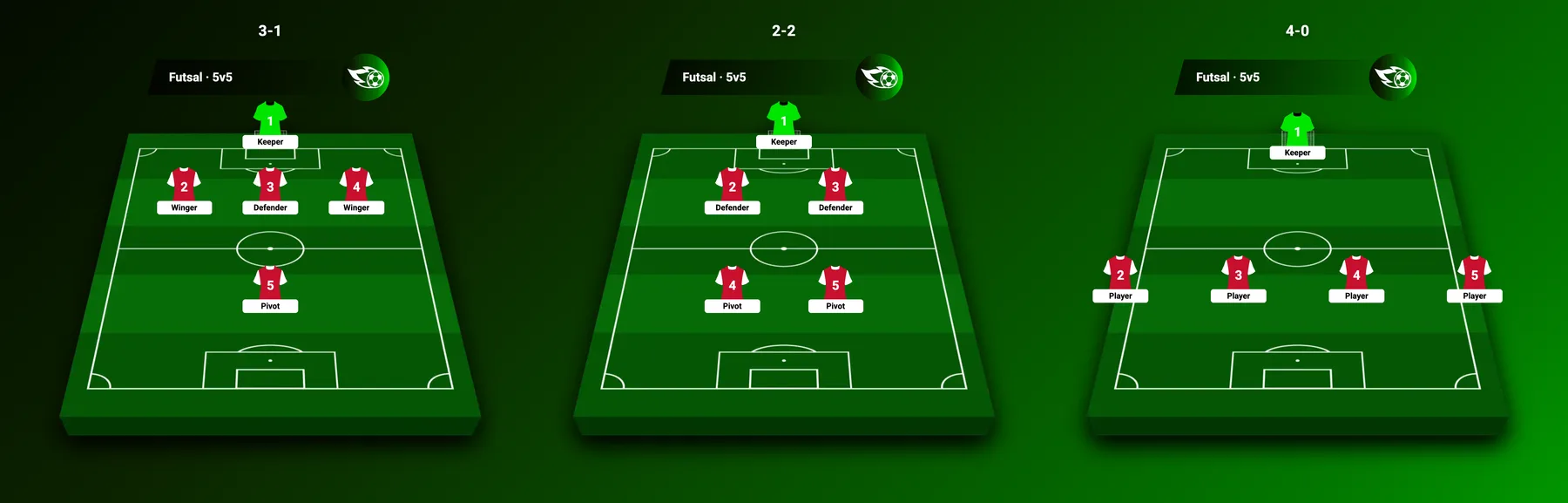
Futsal notation counts outfield players from back to front and leaves the keeper out. So 3-1 means three players behind one pivot. The German FA writes the keeper in as a leading 1 and calls the same shape 1-3-1, which trips people up when they read its coaching material.
3-1. Defender in the middle of three, a winger on each side, pivot ahead. It gives width and one clear target. The German FA recommends it for any team starting futsal, as long as there is a genuine pivot to play it through.
2-2. Two behind, two ahead, a box. It is simple to teach. The German FA's coaching course notes it is rarely seen at higher levels because the tight spacing makes it easy to press.
1-2-1. The diamond. FIFA's manual drills it as a defensive block, and it is the basic shape in which defender, wingers and pivot are easiest to pick out.
4-0. All four outfield players on one line with no fixed pivot, swapping places constantly. FIFA's manual says the attacking side tries to draw the opponents out of their own half and then play into the space behind them. It adds that this tends to suit more advanced, technically sound teams. The German FA says the players must be all-rounders.
Nobody plays one shape for 40 minutes. The manual states that teams move between formations during play, and that at the top level 1-3, 3-1, 2-2 and 4-0 all appear in the same phases of a match.
The flying goalkeeper: five against four
Any player can swap with the goalkeeper during a stoppage, as long as he wears a goalkeeper's shirt carrying his own number. FIFA calls the result a power play: five outfield players against four, with the keeper gone. It is mostly a way to chase a goal, though the manual notes it can also keep the ball when you are ahead.
The cost is an empty net. FIFA's own manual counted 219 such power plays at the 2021 World Cup, and they produced 16 goals, an efficiency of about 7 per cent. Its conclusion is blunt: teams were more likely to concede than to score. That is a good fact to keep in mind next time a coach shouts for the keeper to come up.
Picking a shape for your team
Count your pivots before anything else. One genuine pivot who can hold the ball means 3-1. No pivot, but four players who are comfortable on the ball, means 4-0 is possible. Everything else defaults to 2-2 or the diamond.
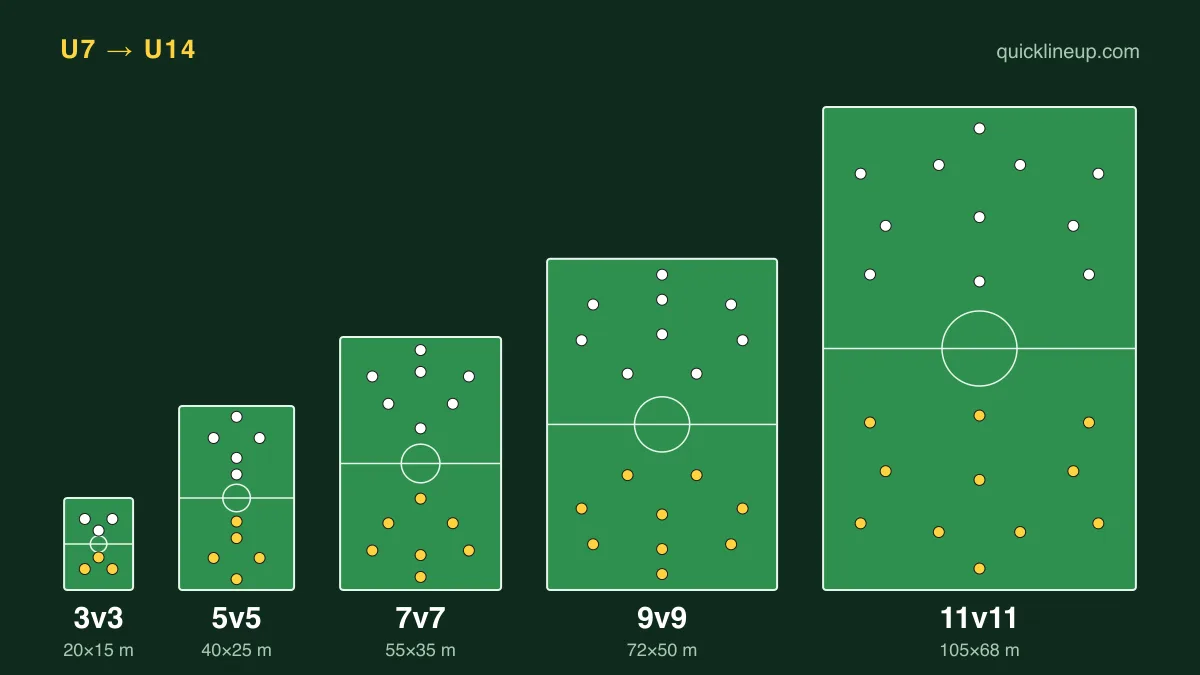
Younger squads are a special case. The German FA's youth format for under-11s uses the futsal pitch for 5v5 but drops the 4-second rule and rotates players in blocks, at least every 3 minutes. Our guide to youth formats by country shows how other federations handle it.
If you are new to the numbers, how many players are on a soccer team covers futsal next to the other formats, and the football tactics glossary explains terms like power play and pressing.
Draw it before you play
With nine possible substitutes and no stoppages for changes, a futsal squad has more lineup decisions than the five on court suggest. Who starts as pivot, who covers when the keeper goes up, who plays which side.
Put those answers on one picture and the arguing happens in the group chat instead of the sports hall. The 5-a-side builder in QuickLineup places a keeper and four outfield players, takes names and exports an image, with no sign-up. Before you book the court, ask the venue one question: are there walls?