Football Tactics Glossary: 30 Terms From False 9 to Low Block
Tactical language moves faster than the game. "Half-space" was a niche word ten years ago; now pundits say it on live TV and assume you know it.
This glossary covers the thirty terms you are most likely to hear in commentary, press conferences and your own team's group chat. Each one starts with a plain definition and, where it helps, names the team or match that made it famous. Most of them are easier to understand as a shape than as a sentence, so the diagrams here come from the same pitch you use in the lineup builder.
How to read a formation
A formation lists the outfield players from back to front. The goalkeeper is never counted, so the numbers always add up to 10: a 4-3-3 is four defenders, three midfielders and three forwards.
A fourth number splits a line in two. In a 4-2-3-1, the midfield is two holders plus three attacking players behind one striker.
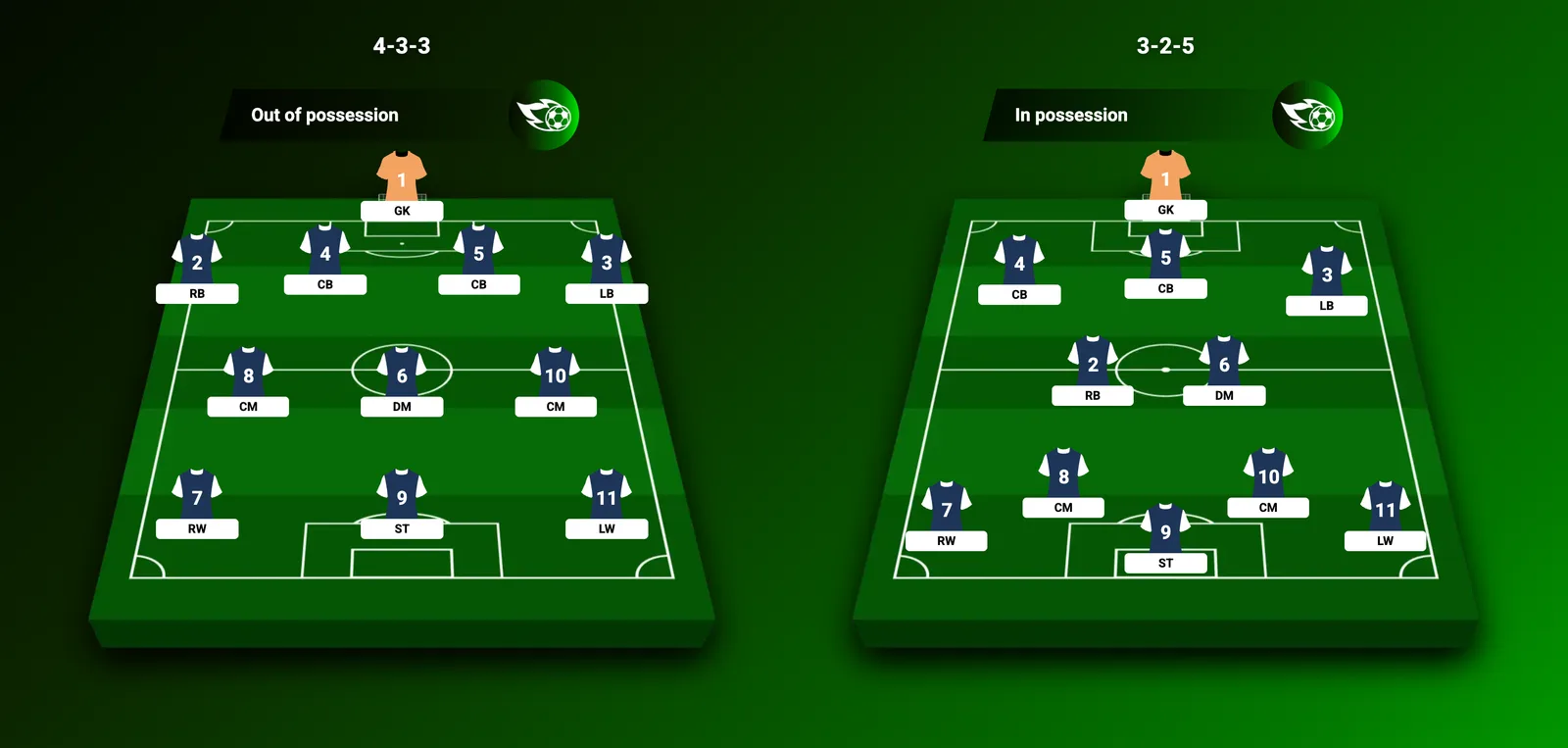
The catch: a formation is only a starting position. The image above is the same eleven players twice. Without the ball they defend in a 4-3-3; with it, the right-back steps inside and the shape becomes a 3-2-5. Most modern tactical vocabulary exists to describe what happens between those two pictures.
In possession
Build-up
Build-up is how a team moves the ball from its goalkeeper and centre-backs into midfield. Short build-up means passing through the lines from the goal kick. Long build-up means going over them, usually toward a tall striker.
Positional play
Positional play (Spanish juego de posición) is a system where players occupy fixed zones and the ball moves to find the free man, rather than players running to the ball. Pep Guardiola is its best-known coach. The practical rule most teams take from it is simple: no two players in the same vertical lane and the same horizontal line.
Half-space
The half-space is the vertical lane between the centre and the wing, one on each side. A player there can see goal, touchline and the middle at once, and he sits in the seam between full-back and centre-back, which is why defenders hate it. The term is a translation of the German Halbraum and spread through tactics blogs in the 2010s.
Overload
An overload means having more players than the opponent in one area of the pitch, typically three against two on a flank. "Overload to isolate" is the next step: pull the defence toward one side, then switch the ball quickly to a winger left one against one on the other.
Third-man run
A third-man run is a pass combination in which player A passes to B, and B immediately lays it on to C, who was already running into space. The defender watching A never sees C coming. It is the most common way to break a compact block without dribbling.
Inverted full-back
An inverted full-back moves into central midfield when his team has the ball instead of overlapping down the wing. Guardiola made it a coached pattern at Bayern Munich in 2013-14 with Philipp Lahm and David Alaba stepping inside. The cover image shows it: the right-back (2) leaves the back four and stands next to the holding midfielder.
False 9
A false 9 is a centre-forward who drops into midfield instead of playing on the last defender. The centre-backs face a bad choice: follow him and open space behind, or stay and let him turn. Lionel Messi was first used this way by Guardiola in Barcelona's 6-2 win at the Bernabéu on 2 May 2009, while Thierry Henry and Samuel Eto'o ran in behind.
Overlap and underlap
An overlap is a run by the full-back around the outside of the winger. An underlap is the same run on the inside, through the half-space. Which one a team uses depends on where the winger wants the ball.
Width and depth
Width means players stretching the pitch toward the touchlines; depth means a player threatening the space behind the defence. Without width the opponent can defend narrow. Without depth, its back line can step up and squeeze the midfield.
Rest defence
Rest defence is the group of players who stay behind the ball during an attack to stop the counter. A common version is 3+2: three defenders plus two midfielders, exactly the base of the 3-2-5 in the cover image. Manchester City's 2022-23 treble side built it by moving John Stones from centre-back into midfield when they had the ball.
Out of possession
Pressing
Pressing is an organised attempt to win the ball back by closing down the player in possession and his passing options at the same time. One player chasing alone is not a press. The difference is whether his teammates move up with him.
Pressing trigger
A pressing trigger is an agreed signal for the whole team to press: a back pass, a bad first touch, a pass toward the touchline, or a player receiving with his back to goal. Triggers stop the press from being a matter of mood.
Gegenpressing
Gegenpressing, or counter-pressing, is pressing immediately after losing the ball, before the opponent can organise its counter-attack. Ralf Rangnick's Hoffenheim used it in the late 2000s, and Jurgen Klopp's Borussia Dortmund turned it into a brand on the way to the 2013 Champions League final.
High, mid and low block
A block is the height at which a team sets up to defend.
| Block | Where the back line stands | Typical use |
|---|---|---|
| High block | near the halfway line | pressing teams, favourites |
| Mid block | a little inside own half | balance of press and protection |
| Low block | around the edge of own box | underdogs, protecting a lead |
A low block gives up the ball in exchange for denying space behind. José Mourinho's Inter, holding on with ten men at Camp Nou in the 2010 Champions League semi-final, is the example most coaches still show.
Compactness
Compactness is the distance between a team's lines and between its players across the pitch. A compact team can be passed around but not through. Diego Simeone's Atlético Madrid, set up in two flat lines of four, is the textbook case.
Zonal marking and man marking
In zonal marking each defender covers an area and deals with whoever enters it. In man marking each defender follows one opponent wherever he goes. Most teams mix them, especially at corners.
Offside trap
The offside trap is the back line stepping forward together, just before a pass, to leave an attacker in an offside position. Under Law 11 of the IFAB Laws of the Game a player level with the second-last opponent is onside, and nobody can be offside directly from a goal kick, throw-in or corner. That last detail is why the trap never works at set pieces taken from the corner flag.
Transitions
Transition
A transition is the few seconds after the ball changes teams. The attacking transition is what you do when you win it, the defensive transition what you do when you lose it. Many goals are scored in transitions because neither team is in its planned shape.
Counter-attack
A counter-attack is a fast attack launched straight after winning the ball, aimed at the space the opponent left while attacking. It is the natural partner of a low block: defend deep, then run into the grass behind.
Tactical foul
A tactical foul is a deliberate foul to stop a counter-attack, usually in midfield and usually on the player carrying the ball. Law 12 treats stopping a promising attack as a yellow-card offence, so the fouling player takes a booking to buy his team time to reorganise.
Player roles
Regista
A regista is a deep-lying playmaker who sets the tempo from in front of the defence, mostly with passing rather than running. Andrea Pirlo is the model: converted from attacking midfield at Brescia under Carlo Mazzone, then made the pivot of Carlo Ancelotti's Milan, which won the 2003 Champions League final against Juventus on penalties.
Mezzala
A mezzala (Italian for "half-wing") is a central midfielder who plays on the side of a midfield three and attacks the half-space and the box. In a 3-5-2 the two mezzalas decide whether the team looks attacking or cautious.
Box-to-box midfielder
A box-to-box midfielder covers the whole length of the pitch, from defending his own penalty area to arriving in the opponent's. The role asks for stamina first and passing second.
Wing-back
A wing-back is a wide player in a back three or back five who owns the entire flank alone. With the ball he plays as a winger, without it as a full-back. Antonio Conte's Chelsea won the 2016-17 Premier League with Victor Moses and Marcos Alonso in these roles. More on that shape in the rise of three-man defences.
Inverted winger
An inverted winger plays on the side opposite his stronger foot, a right-footer on the left, so he can cut inside and shoot or pass into the box. Arjen Robben, a left-footer starting on the right, made the move so predictable that it became a joke, and it still worked.
Target man
A target man is a striker, usually tall and strong, whose job is to hold up long passes and win headers so his teammates can join the attack. He is the easiest answer to a high press: skip it.
Libero (sweeper)
A libero is a free defender who plays behind the other defenders, marks nobody and cleans up whatever gets through. Helenio Herrera's Inter used Armando Picchi in this role on the way to winning the European Cup in 1964 and 1965.
Sweeper-keeper
A sweeper-keeper is a goalkeeper who defends the space behind a high back line, leaving his box to clear through balls. Manuel Neuer at the 2014 World Cup is the reference. The high block described above is only possible with one.
Two old words still in use
Catenaccio
Catenaccio (Italian for "door bolt") was the defensive system built around a libero behind man-markers, associated with Herrera's Inter of the 1960s. Today the word is used loosely, often unfairly, for any team that defends deep.
Total Football
Total Football was the idea that any outfield player could take any position as long as the shape stayed intact. Rinus Michels' Ajax and Netherlands, with Johan Cruyff, made it famous; the Netherlands reached the 1974 World Cup final and lost 2-1 to West Germany.
The same eleven, two shapes
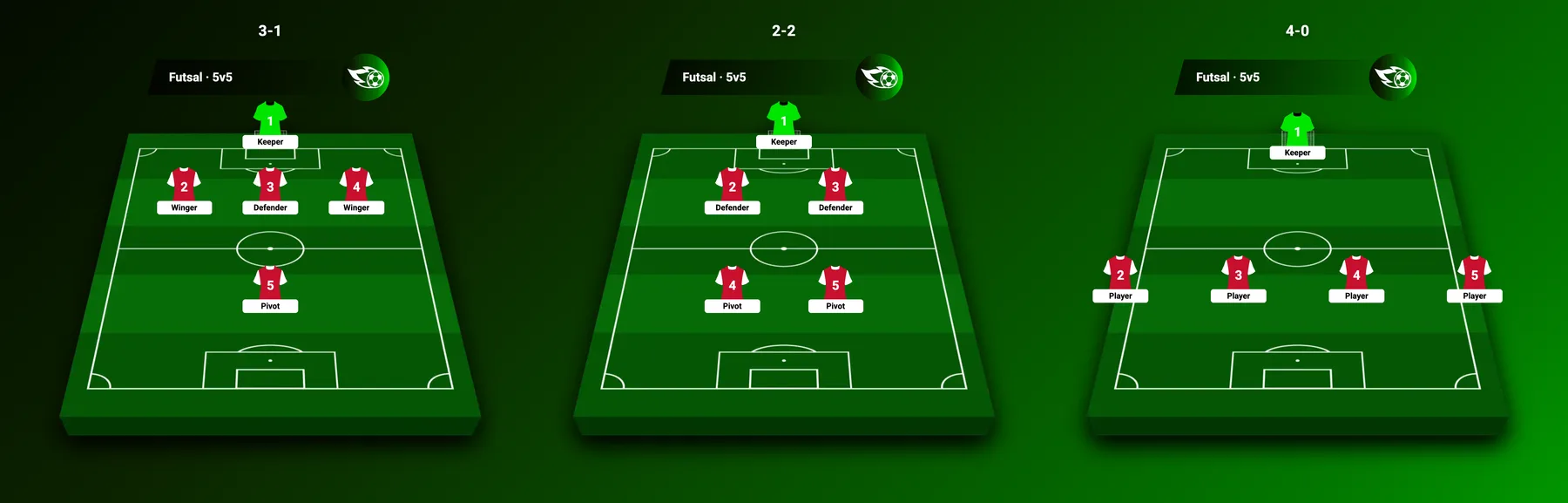
Most of the words above describe movement, and movement is hard to show in a single formation graphic. The simplest way we have found is two pictures side by side: the defensive shape and the attacking one.
- Open the Quick Lineup builder and pick a team size between 5 and 11.
- Choose the formation you defend in, name your players and download the image.
- Drag the players to where they stand with the ball (the inverted full-back, the mezzala in the half-space, the 3+2 rest defence) and download again.
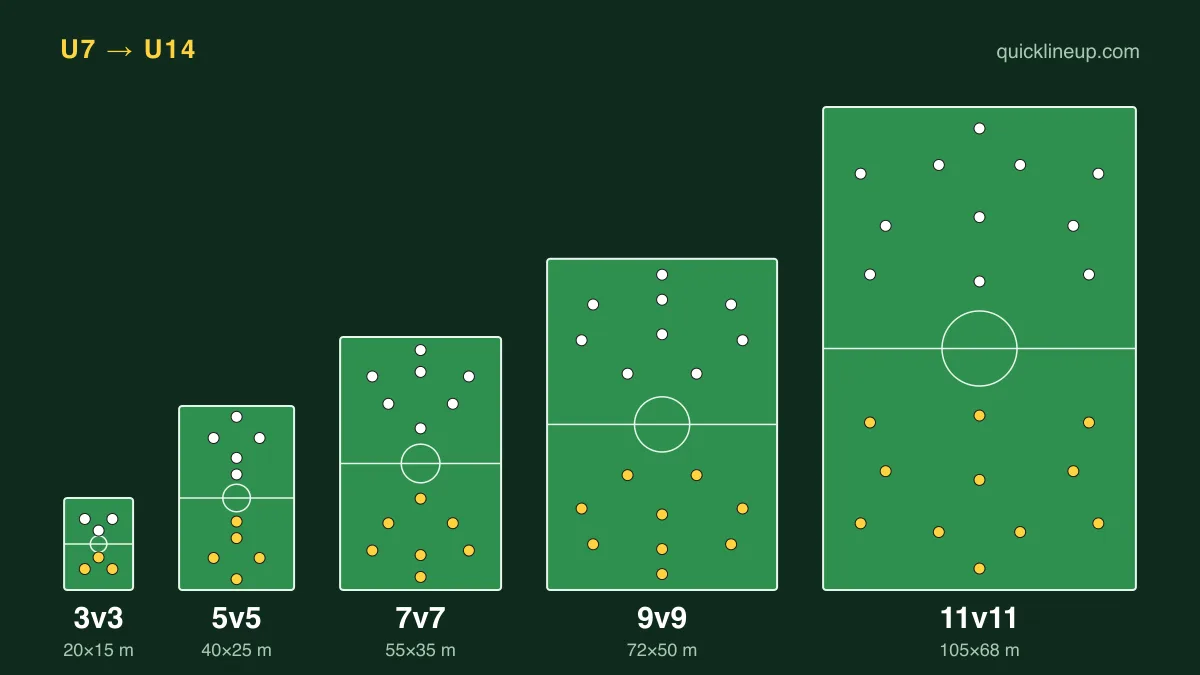
That is exactly how the cover image here was made. For smaller games the idea is the same on a 5-a-side pitch, where one player stepping inside changes the whole team.
If you want the formations themselves in more depth, the football formations guide compares every system these terms get used in, and soccer positions explained covers the basic roles. The terms are the easy part. Seeing your own team make a 3-2-5 without being told is harder, and it usually starts with one full-back who decides to try it.