How Many Players Are on a Soccer Team? Every Format Explained

Eleven. That is the answer people are looking for, and it is correct exactly once: for standard, full-pitch football.
Most football played on a given weekend is not that. It is five-a-side after work, seven-a-side on a rented pitch, nine-a-side for eleven-year-olds. Each has its own number, and the number changes almost everything else about the game.
The short answer, by format
Goalkeeper included in every figure below.
| Format | Players per side | Where it is played |
|---|---|---|
| Standard football | 11 | Professional and adult amateur leagues |
| 9-a-side | 9 | Youth football, typically ages 11-12 |
| 8-a-side | 8 | Rented pitches, youth football |
| 7-a-side | 7 | The most common small-sided format worldwide |
| 6-a-side | 6 | Indoor and short-pitch leagues |
| 5-a-side | 5 | Indoor and cage football |
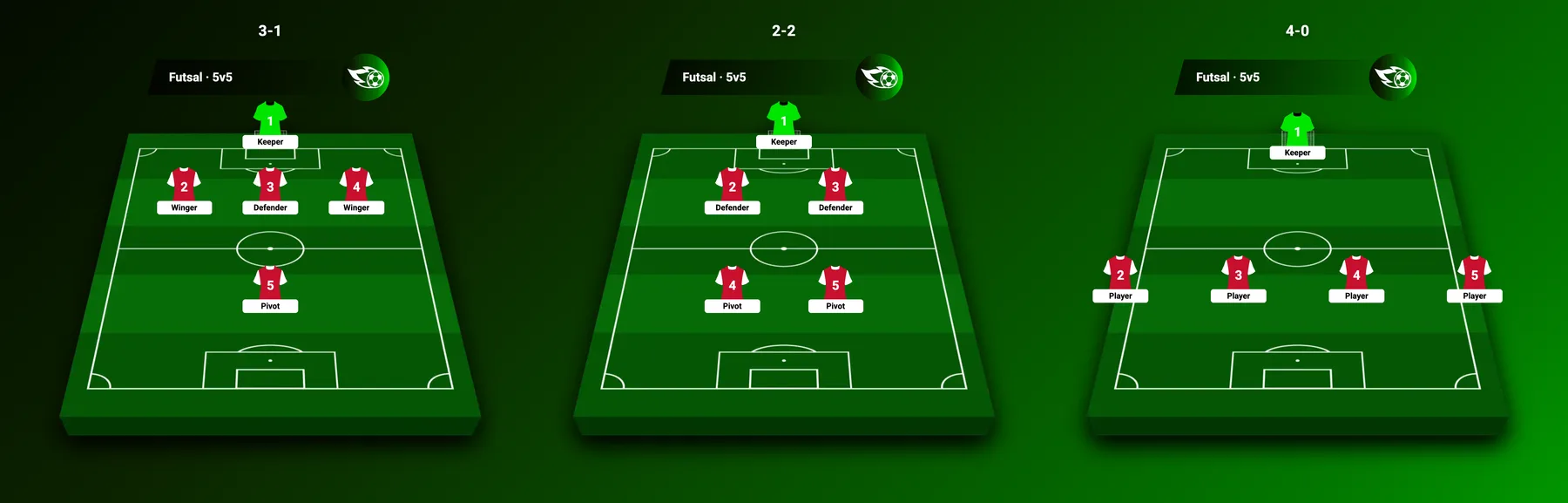
| Futsal | 5 | Indoor hard court, FIFA-regulated |
Eleven-a-side: the numbers behind the number
On the pitch: 11 per side, one of whom must be the goalkeeper. This is set out in Law 3 of the Laws of the Game and is the same from the World Cup final down to a Sunday league.
Minimum to play: 7. A match cannot start, and cannot continue, if a team drops below seven players. This is the rule behind the occasional abandoned match after multiple red cards.
Substitutes: up to 5 in most competitive football, used across a maximum of three stoppages plus half-time. The five-substitute allowance began as a temporary measure in 2020 and became a permanent part of the Laws from the 2022-23 season. One extra substitution is allowed if the match goes to extra time.
Squad size is a separate question from matchday numbers. Professional clubs typically register 25 or more players across a season. National teams take 23 to 26 to a major tournament, the exact figure depending on what that competition's rules allow.
So a single club can accurately be described as having 11, 16, 26 or 30 players depending on which question is being asked.
Small-sided football: the number changes the game
Reducing the team is not simply the same sport with fewer people. Two things change immediately.
Everyone defends. On a full pitch a striker can stay high and wait. On a short pitch there is nowhere to stand that is not part of the defensive shape, because the distance from one goal to the other is short enough that a turnover reaches your own box in seconds.
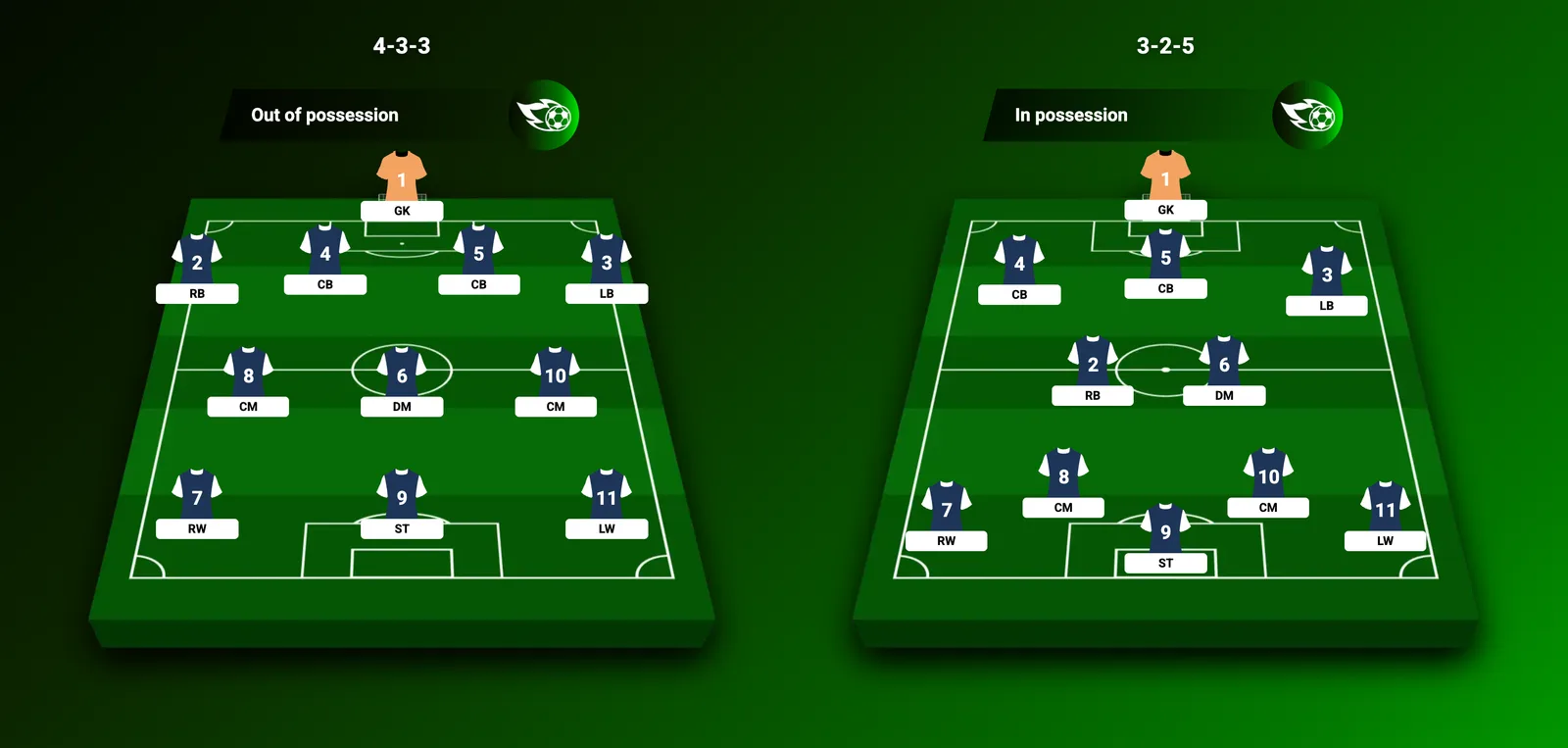
Formations lose a line. An 11-a-side shape has four bands: defence, holding midfield, attacking midfield, attack. Take away four players and you have three bands at most, usually two. This is why 7-a-side formations are written as 1-2-3-1 rather than 4-4-2, because the goalkeeper is counted: with six outfield players the keeper is genuinely part of the structure.
Rough guide to what each format tends to use:
- 5-a-side: 1-2-2 or 1-1-2-1. Two flat pairs, or a diamond. Nobody is a specialist.
- 6-a-side: 1-2-1-2 or 1-2-2-1. One player has to sit in front of the defence.
- 7-a-side: 1-2-3-1 or 1-3-2-1. The most balanced format; a single striker is enough.
- 8-a-side: 1-3-3-1 or 1-2-3-2. Width starts to matter, because there is finally room on the flanks.
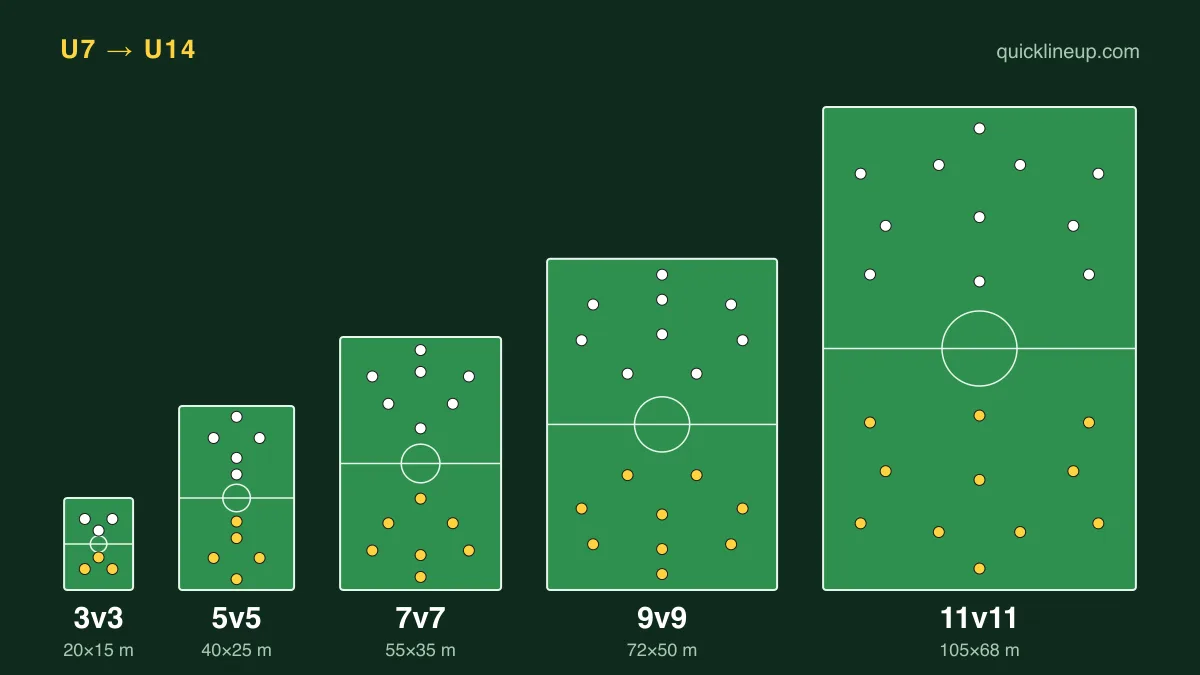
The lineup builder covers every squad size from 5 to 11 with the right pitch proportions for each format, so a 6, 7 or 8-a-side team is not drawn on a full-size pitch. Three small formats also have their own pages, with the formation list already set to that size: the 5-a-side lineup builder, the 7-a-side lineup builder and the 9-a-side lineup builder for 9v9 youth football.
Futsal is five, but not the same five
Futsal is often described as indoor five-a-side, which undersells how different it is.
It is played on a hard court rather than turf, with a smaller ball weighted to bounce less. The substitution rule is the real distinction: changes are rolling and unlimited, so players leave and enter during play, the way ice hockey works. FIFA futsal competitions allow squads of up to 14 players, and in a fast game most of them will play.
That single rule changes how teams are picked. A futsal squad is not eleven players and some spares; it is a rotation where nearly everyone is expected to play. If you organise futsal rather than turf football, that rotation is the thing to plan the squad around: name a first four you trust and a second four who can hold the game, rather than five starters and a bench.
Youth football: the number goes up with age
Children do not play eleven-a-side, and the reason is space rather than tradition. Twenty-two small players on a full-size pitch produces a game where most of them never touch the ball.
Most national associations therefore use a step-up structure. The England FA's format, which many other associations broadly mirror, runs:
- Under 7 to Under 8: 5-a-side
- Under 9 to Under 10: 7-a-side
- Under 11 to Under 12: 9-a-side
- Under 13 and above: 11-a-side
Check your own association's rules rather than assuming, because the age bands and pitch sizes differ between countries.
How many people you actually need to organise a game
The format number is the minimum. It is not the number to invite.
Turnout at amateur level runs well below confirmations. Planning a 7-a-side match around exactly 14 people means the match falls through the first time two of them cancel on the morning. Most regular organisers gather two to four extra per side, so a 7-a-side game has 16 to 18 confirmed and starts with 14.
The other half of the problem is who plays where, and that one is solved before you arrive rather than in the car park. Laying out the shape and sending it to the group the night before takes about two minutes on the lineup builder and removes the argument entirely.
Where to go from here
If you play eleven-a-side and want to compare systems, the complete guide to football formations covers every shape side by side, and the guide to what each soccer position does fills in the roles inside them. If you organise an amateur team where attendance is unpredictable, the formation guide for amateur teams deals with that specific problem.
And if the answer you came for was just the number: eleven, including the goalkeeper, with seven as the point at which the referee sends everyone home.