Formation Guide for Amateur Teams: Tactics That Survive Sunday Morning

Most tactical writing assumes things amateur football does not have. A settled squad. Training on Tuesdays. Eleven players who all know what a half-space is.
What you actually have is a WhatsApp group where four people answer "maybe", a centre-back who might be working, and one striker who is genuinely good and knows it. Any formation you pick has to survive that. This is a guide to picking one that does.
Start from the constraint, not from the system
Professional football chooses a style and then find players who fit it. You have to do the reverse, because you cannot sign anyone and you cannot drop anyone who paid their share of the pitch fee.
So the question is not "what is the best formation". It is: which formation asks the least of the things I don't have?
Three things you don't have, and what each one rules out:
- No training time. Rules out anything with rehearsed patterns (rotations, pressing triggers, overlapping runs that need timing. If it has to be practised, it will not happen.
- Unpredictable attendance. Rules out any system whose whole logic sits on one player. Lose your only holding midfielder and a 4-2-3-1 stops being a 4-2-3-1.
- Uneven fitness. Rules out roles that require covering seventy metres in both directions all game. Wing-back is the most demanding position in football and the least suited to a Sunday side.
That leaves you with fewer options than the internet suggests, which is good. Fewer options means a faster decision.
Three systems that hold up
4-4-2: the one that needs no explanation
Four defenders, four midfielders, two strikers. Two flat lines, two forwards.
Its real advantage is not tactical, it is social: every player can see their own job from where they are standing. The right-back marks the left winger. The left midfielder covers the left touchline. The two strikers stay near each other. Nobody has to be told twice.
It also splits the pitch into eight roughly equal zones, which means the ball is rarely more than ten metres from someone whose job it is to be there. In a league where most goals come from unmarked players rather than from clever patterns, that is worth more than sophistication.
What it costs you: two central midfielders will be outnumbered against a three-man midfield. You will spend spells of the game watching the ball go past you in the middle. Accept it, or drop one striker.
Full breakdown: 4-4-2 formation guide.
4-2-3-1: when you have one player who is clearly better
Four defenders, two holding midfielders, three attacking midfielders, one striker.
Use this when one player in your squad is a level above everyone else and plays centrally. The number ten slot exists to give that player the ball in space and let them decide what happens. The two holders behind exist so that when they lose it, and they will, because good players take risks, the team is not immediately exposed.
The condition: you need two players willing to sit. Not two good players, two disciplined ones. The whole system depends on the double pivot staying put while everyone in front of them attacks. If both drift forward you have a 4-0-5-1 and a very tired back four.
Full breakdown: 4-2-3-1 formation guide.
4-3-3: when your best players are wide and fast
Four defenders, three central midfielders, three forwards.
This is the one to pick if you have two genuinely quick wide players. It puts them permanently high and wide against full-backs who, at amateur level, are usually the least mobile players on the pitch. That is a mismatch you can use every single week without any coaching.
Stamina is the condition here. Three central midfielders have to cover the whole middle of the pitch, and your wingers are not coming back to help. If your midfield is three people who play once a fortnight, this becomes a 4-3-3 for twenty minutes and a shapeless mess after that.
Full breakdown: 4-3-3 formation guide.
Comparing them on what actually matters
Not on possession stats. On the things that decide amateur matches.
| 4-4-2 | 4-2-3-1 | 4-3-3 | |
|---|---|---|---|
| How much explaining before kick-off | 30 seconds | 2 minutes | 2 minutes |
| Survives a missing player | Well | Poorly | Moderately |
| Fitness demanded | Moderate | Moderate | High |
| Needs one standout player | No | Yes | No |
| Risk if it goes wrong | Outnumbered in midfield | Lone striker isolated | Full-backs exposed |
| Good first choice for a new team | Yes | No | No |
If you are reading this before your first match with a new group of players, the honest answer is the left column.
The rule that matters more than the formation
Decide it before you get to the pitch, not on it.
Those five minutes before kick-off, when eleven people are putting shin pads on and arguing about who goes in goal, is the worst possible moment to design a tactical system. Positions get assigned by volume rather than by suitability. The two people who want to play up front both play up front. Nobody is at right-back.
Sending the shape to the group the night before removes all of that. It also means the argument, if there is one, happens in a chat instead of on the pitch. You can lay out an XI on the football lineup builder in about two minutes, download it as an image and post it. That is the entire process.
When only nine turn up
This happens. Plan for it once and you never have to improvise again.
Most amateur leagues let a match start with a minimum of seven players per side, and the Laws of the Game require a game to be abandoned if a team drops below seven. So nine is playable. It just needs a decision about what you are giving up, because you are giving up something.
Here is the order to remove players, and why:
- Take out a striker first. Two up front becomes one. You lose attacking presence but you keep the pitch covered, and a lone striker still occupies two centre-backs.
- Then take out a central midfielder, not a wide one. This feels wrong and it is correct. Losing width means the opposition full-backs are free, which turns every one of their throw-ins into an attack. Narrow and outnumbered centrally is survivable; wide open on both flanks is not.
- Never take out a defender to keep two strikers. Every Sunday team tries this once.
A nine-player side is a 4-3-1 or a 4-2-2. Both are fine. What is not fine is nine players in the shape of eleven, with two holes nobody has been told about.
For small-sided games the maths changes completely
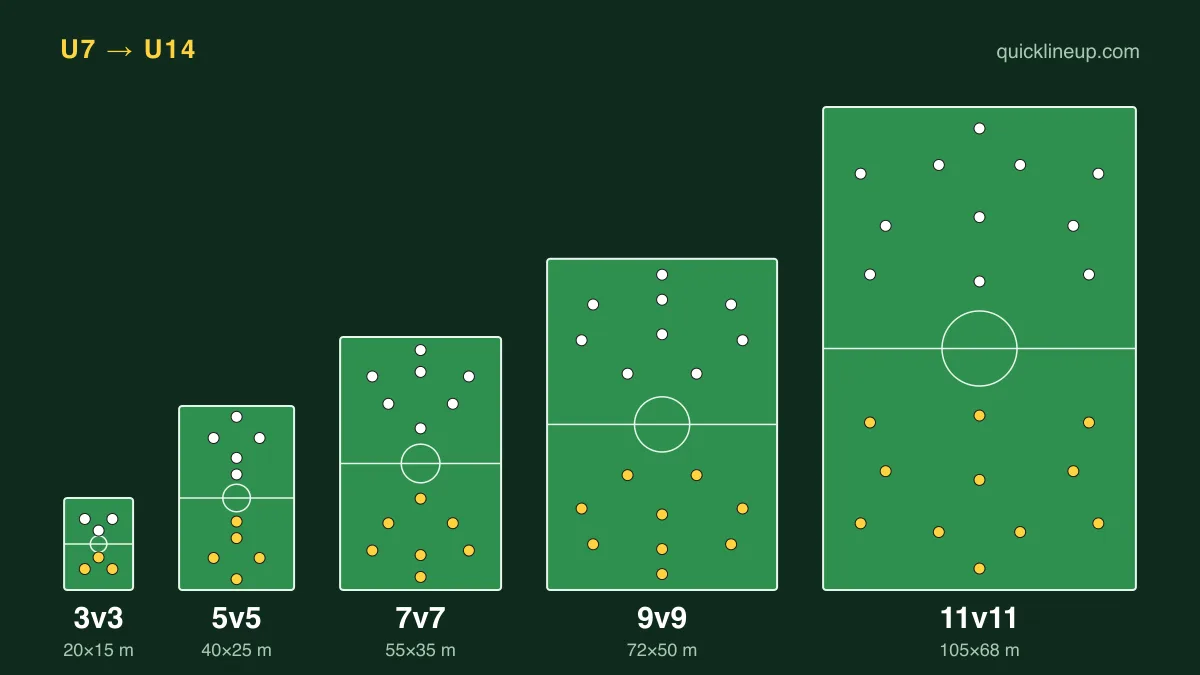
If you play 6, 7 or 8-a-side rather than full 11s, most of the above stops applying. On a smaller pitch there is no room for two banks of four, distances are short enough that everybody defends, and the goalkeeper is genuinely part of the build-up.
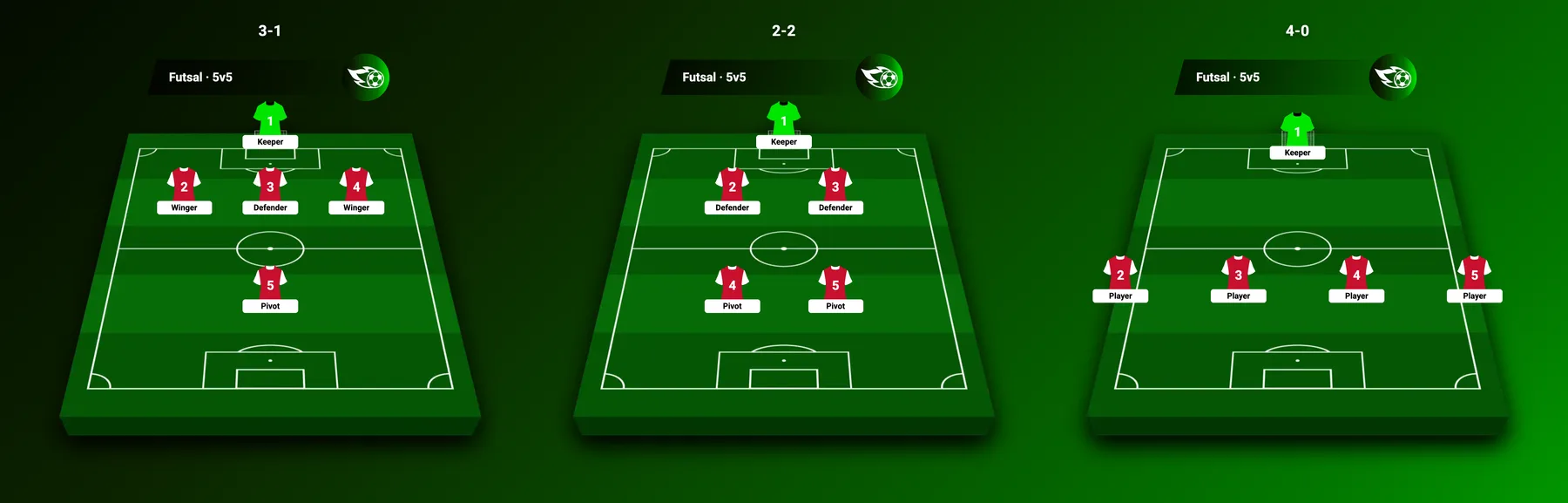
Those formats have their own logic. The lineup builder covers every squad size from 5 to 11 with the right pitch proportions for each, and there are dedicated 5-a-side, 7-a-side and 9-a-side builders, so you can set up a small-sided team without squeezing it onto an 11-a-side pitch.
Where to go next
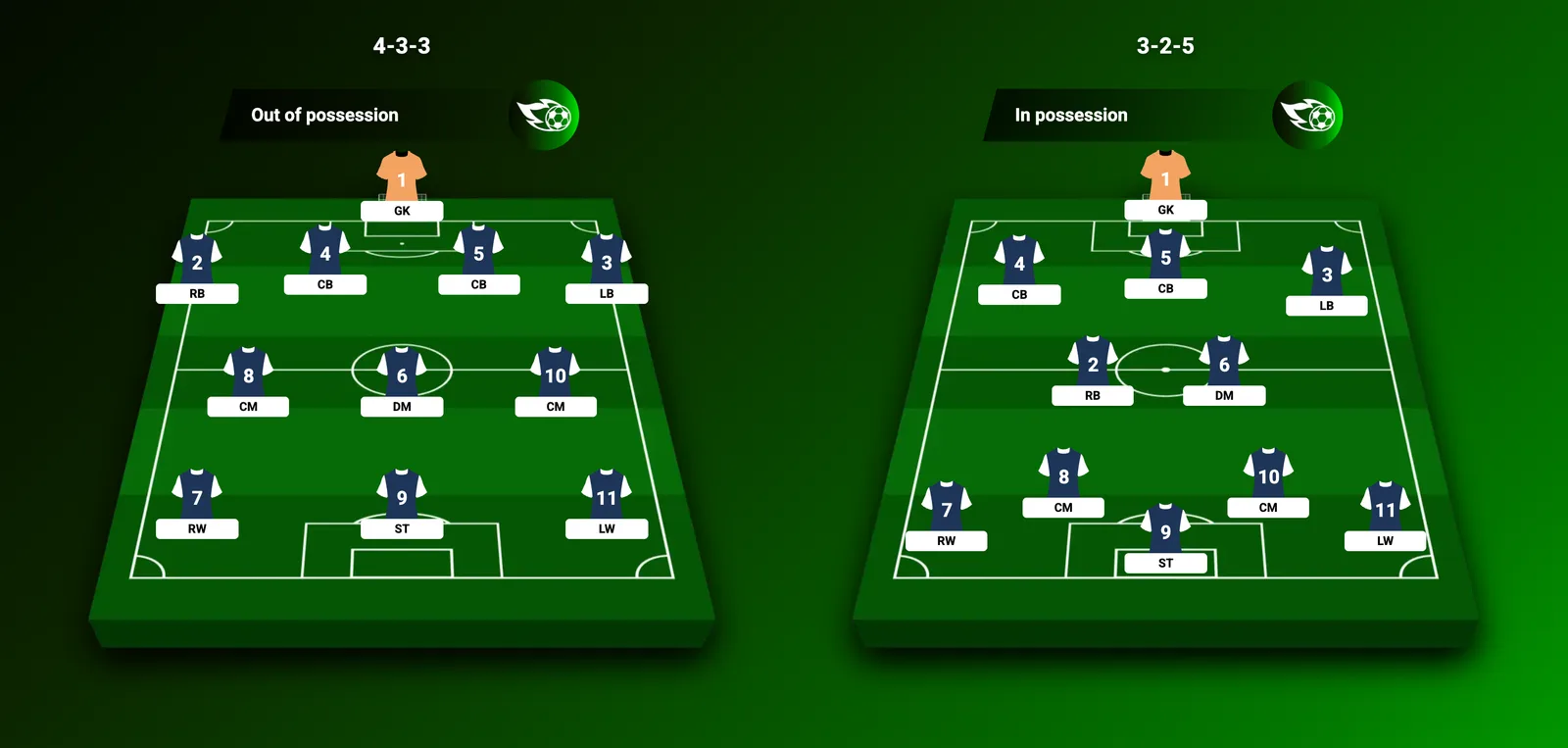
If you want to see how the systems above compare with every other shape, including the three-at-the-back family that has been spreading downward from the professional game, see the complete guide to football formations lays them out side by side.
But pick something this week rather than reading three more guides. The team that agreed a shape on Saturday night beats the team still debating it at 9:55 on Sunday morning, almost regardless of which shape it was.