Why Three-Man Defenses Are Becoming More Popular in Modern Football
For about thirty years, three at the back meant one of two things: a team from Italy, or a team hanging on. It was what you did to protect a lead or to survive a better opponent.
That is no longer what it means. Back threes now show up in sides that dominate the ball, and the reason has almost nothing to do with defending.
The change that actually caused it
In June 2019 the Laws of the Game changed so that a goal kick no longer had to leave the penalty area before another player could touch it. A defender could now receive the ball standing six yards from his own goal, legally, while an opponent stood next to him.
One adjustment moved the fight over possession thirty metres closer to the goalkeeper. Pressing teams responded by sending forwards right up to the edge of the six-yard box. Building teams had to find a way to pass through that.
Counting solves it. Against a front two, a back four plus a goalkeeper is five against two, but two of those five are full-backs standing near the touchline where the ball cannot easily reach them under pressure. A back three plus a goalkeeper gives you four central players against two, all of them close enough to pass to each other, with the wing-backs already high and wide as the outlet.
That is the whole argument. Three at the back is a build-up decision that happens to also be a defensive shape.
The shapes in the family
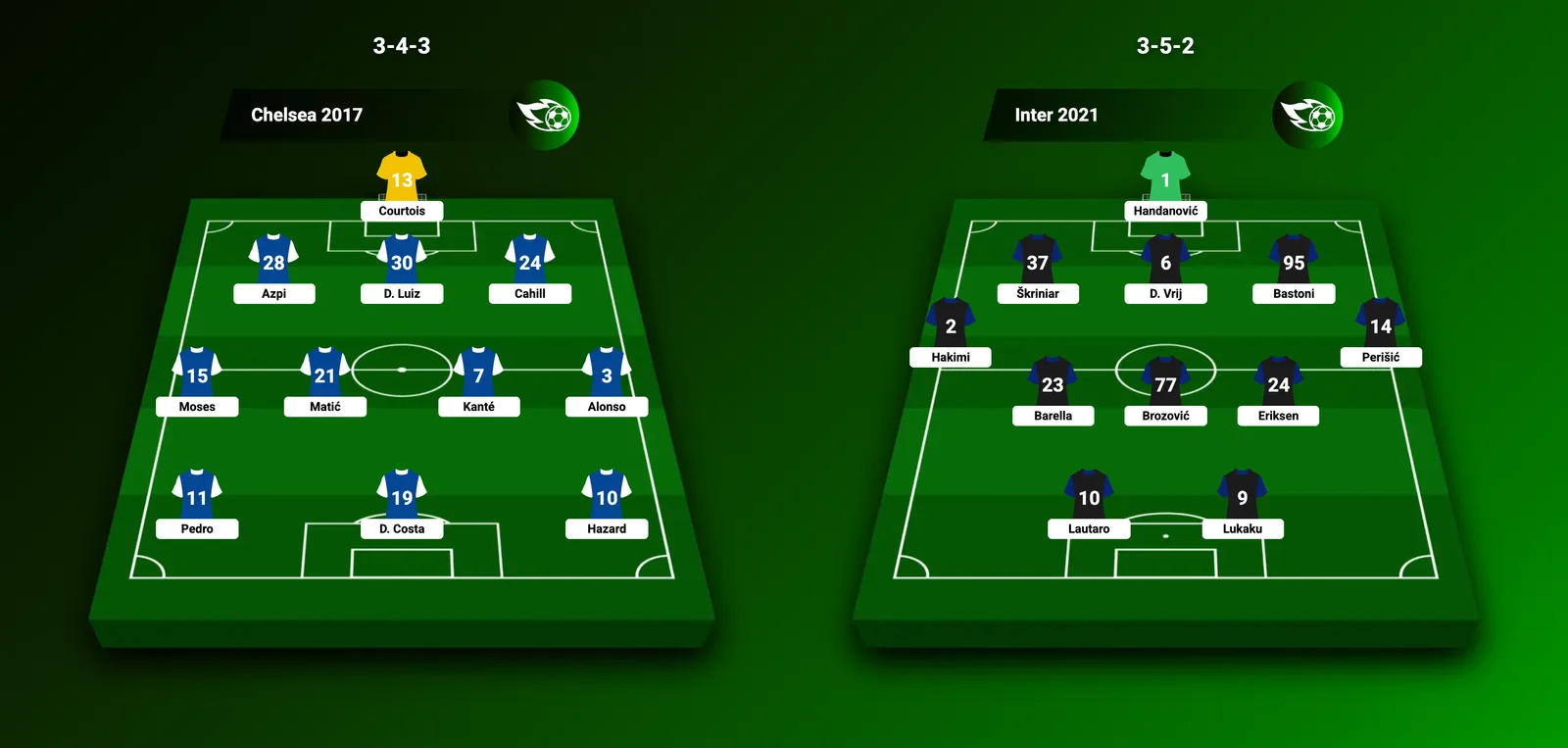
They share a back three and differ entirely in what happens in front of it.
| Shape | Players held high | Best against | Trade-off |
|---|---|---|---|
| 3-5-2 | 2 | Teams playing two central midfielders | No natural width unless wing-backs commit fully |
| 3-4-3 | 3 | Teams that defend deep | Four midfielders can be walked past centrally |
| 3-4-2-1 | 3 | Teams leaving space between lines | Depends heavily on two creative players staying fit |
| 5-2-3 | 3 | Almost nothing; it is a specialist shape | Only two central midfielders behind three forwards |
The 3-4-2-1 is the one that spread furthest. Antonio Conte built a title-winning Chelsea side around it, and the reason it travels well is that the two players behind the striker do not need to be quick or physically dominant. They need to find space between the opposition's midfield and defence. Most squads have someone who can do that.
3-5-2 or 5-3-2? They are usually the same team
This confuses more people than any other point in the topic, so it is worth being blunt about it.
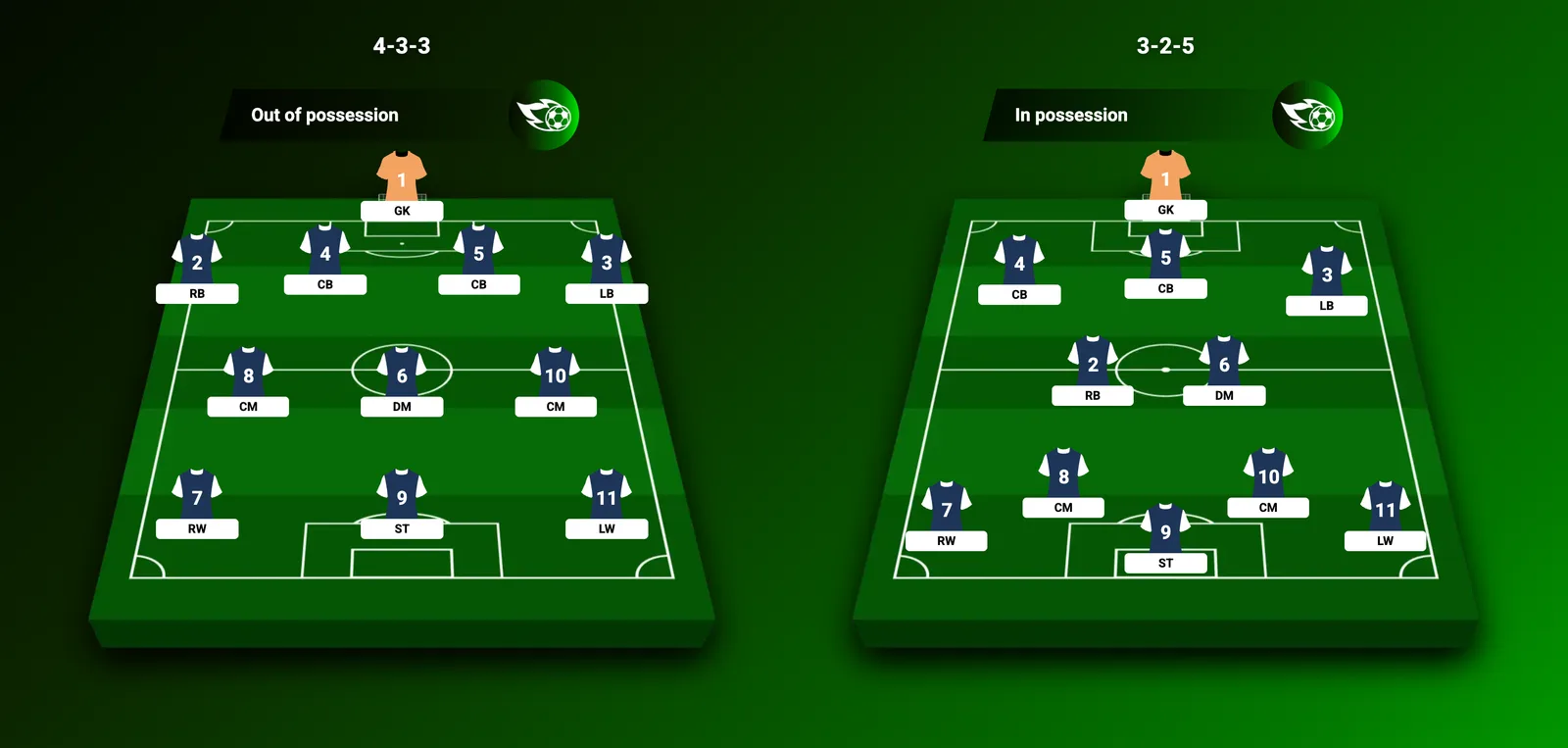
A team lines up with three centre-backs and two wing-backs. When it has the ball, the wing-backs advance to the halfway line and beyond: on paper that is a 3-5-2. When it loses the ball, those same two players sprint back level with the centre-backs: now it is a 5-3-2.
Same eleven people. Same instructions. Two names, because the shape genuinely changes several times a minute.
By convention a team is named for its out-of-possession shape, which is why you will see a side described as a 5-3-2 in a match report and a 3-5-2 in the same week's tactical analysis. Neither is wrong.
If you want to see this rather than read it, put eleven players into a 3-5-2 on the lineup builder, then switch the formation to 5-3-2 and watch which two players move. It is only ever those two.
Where it still breaks
Two problems remain with the system, that have not been solved, only managed.
The wing-backs cover more ground than anyone else on the pitch. Both touchlines, both boxes, for ninety minutes. It is the most physically demanding role in football, and there is no version of a back three that does not require it. When one wing-back is injured, tired, or simply not that kind of athlete, the shape stops working: the team either loses all its width or leaves a flank open.
Three centre-backs against three forwards means nobody is spare. A back four defending against two strikers always has a free man to cover a mistake. A back three against a front three does not. Every centre-back is occupied, and the moment one is beaten in a duel there is a striker running at the goalkeeper. The usual fix is to drop a midfielder into the line, which turns the problem into a midfield problem instead of removing it.
Hence the back three being far more common in professional football than at amateur level. It asks for two specialist athletes and three defenders comfortable defending in isolation, and most Sunday sides have neither. If that describes your team, our formation guide for amateur teams covers what works better in that setting.
What to take from it
Three at the back is not a more defensive system. It is a way of getting an extra passer into the first phase of build-up, and the price is paid by two players on the flanks.
Judge it by where the wing-backs are standing. If they are on the halfway line, you are watching an attacking team. If they are level with the centre-backs, you are watching a defensive one. The number of centre-backs tells you almost nothing on its own.
For a side-by-side comparison of every system covered on this site, see the complete guide to football formations.