Soccer Positions Explained: All 11 Roles and What the Numbers Mean
Commentators still say "he's a proper number 6" about a player wearing 14.
That sentence only makes sense because of a numbering system that stopped describing reality more than thirty years ago. The numbers survived anyway. They stopped being shirt numbers and became role names, which is why a coach can say "we need a 10" and everyone in the room pictures the same kind of player.
Here is what each of the eleven roles does, where the numbers came from, and why they move around when the formation changes.
The eleven positions and their numbers
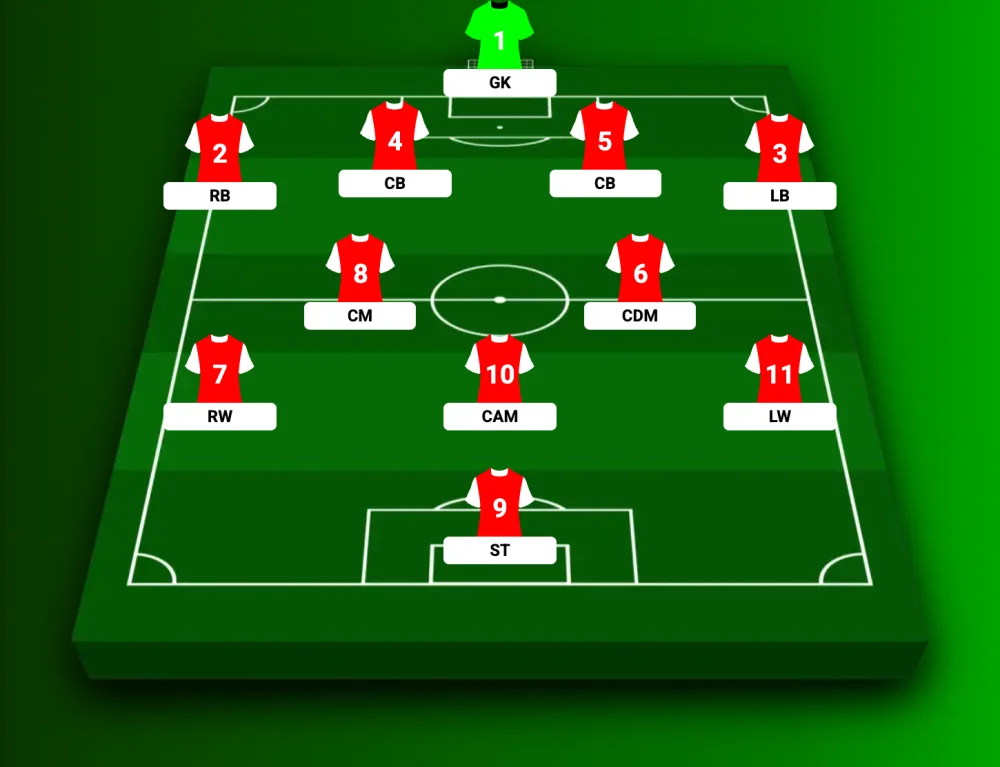
| No. | Position | Job in one line |
|---|---|---|
| 1 | Goalkeeper | The only player allowed to use hands, inside the penalty area only |
| 2 | Right back | Defends the right flank and provides width going forward |
| 3 | Left back | The same on the left |
| 4 | Centre back | Central defender, usually the one who steps out to press |
| 5 | Centre back | Central defender, usually the one who covers behind |
| 6 | Defensive midfielder | Screens the back four and starts the passing |
| 7 | Right winger | Attacks from wide on the right |
| 8 | Central midfielder | Box to box, links defence and attack |
| 9 | Striker | Plays on the shoulder of the last defender, scores |
| 10 | Attacking midfielder | Operates between the opposition midfield and defence |
| 11 | Left winger | Attacks from wide on the left |
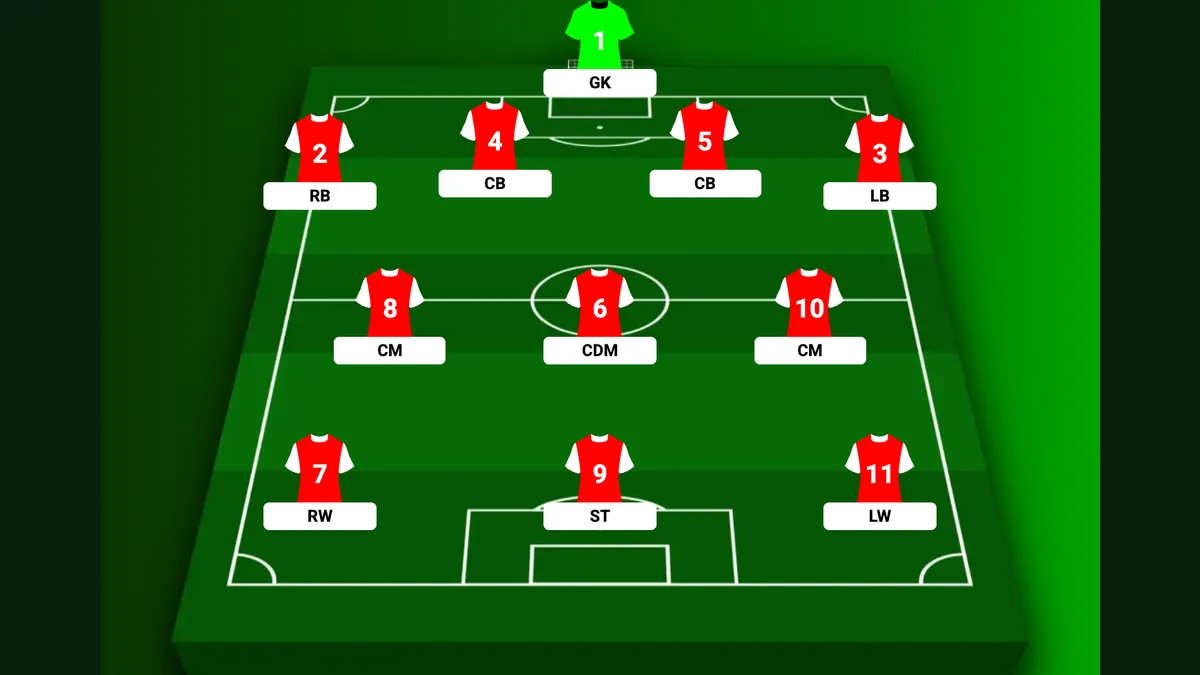
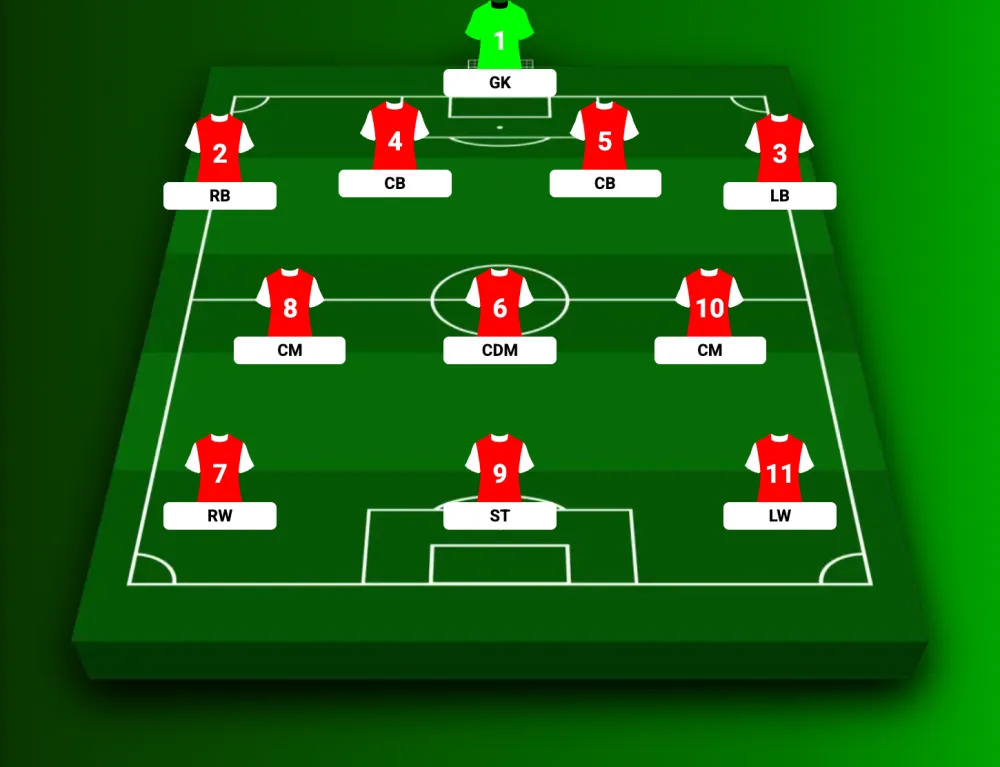
Read that diagram carefully, because the orientation catches people out. The goalkeeper is at the top, so the team is attacking towards you. That puts the right back on the left of your screen, exactly as it would look if you stood behind the opposition goal.
Where the numbers actually came from
Not from a committee. From a formation nobody plays any more.
The first recorded numbered jerseys go back to 1911, worn by the Australian sides Sydney Leichhardt and HMS Powerful. England followed on 23 March 1914, when the English Wanderers faced Corinthians at Stamford Bridge. South America got there on 10 June 1923. Numbering arrived in Europe on 25 August 1928, the day The Wednesday played Arsenal and Chelsea hosted Swansea Town.
The system those teams used mapped onto the 2-3-5 "pyramid", the dominant shape of the era. Numbers ran from the back forward:
- Goalkeeper — 1
- Two full backs — 2 and 3
- Three half backs — 4, 5 and 6
- Five forwards — 7, 8, 9, 10 and 11
The 1933 FA Cup final between Everton and Manchester City used a similar arrangement, but The Football League did not make numbers compulsory until the 1939-40 season.
Then the shapes changed and the numbers did not. The five forwards shrank to three. The three half backs became two central midfielders and a defender. The 6, once the left half, ended up as the deepest midfielder. The 10, once an inside forward, dropped into the gap behind the striker. Every "number as role" you hear today is a fossil of the 2-3-5.
Why nobody wears the right number any more
The FA switched to persistent squad numbers in 1993. A player picks a number and keeps it for the season, no matter which position they start in. The 1993 Football League Cup final between Arsenal and Sheffield Wednesday was the first showing, and it became standard across the Premier League the following season.
The World Cup had done it four decades earlier, giving every man in a 22-man squad a fixed number from 1 to 22 from the 1954 tournament onwards.
So the link broke. The vocabulary did not.
The same numbers, a different shape
Change the formation and the roles move, even though the numbers stay put.
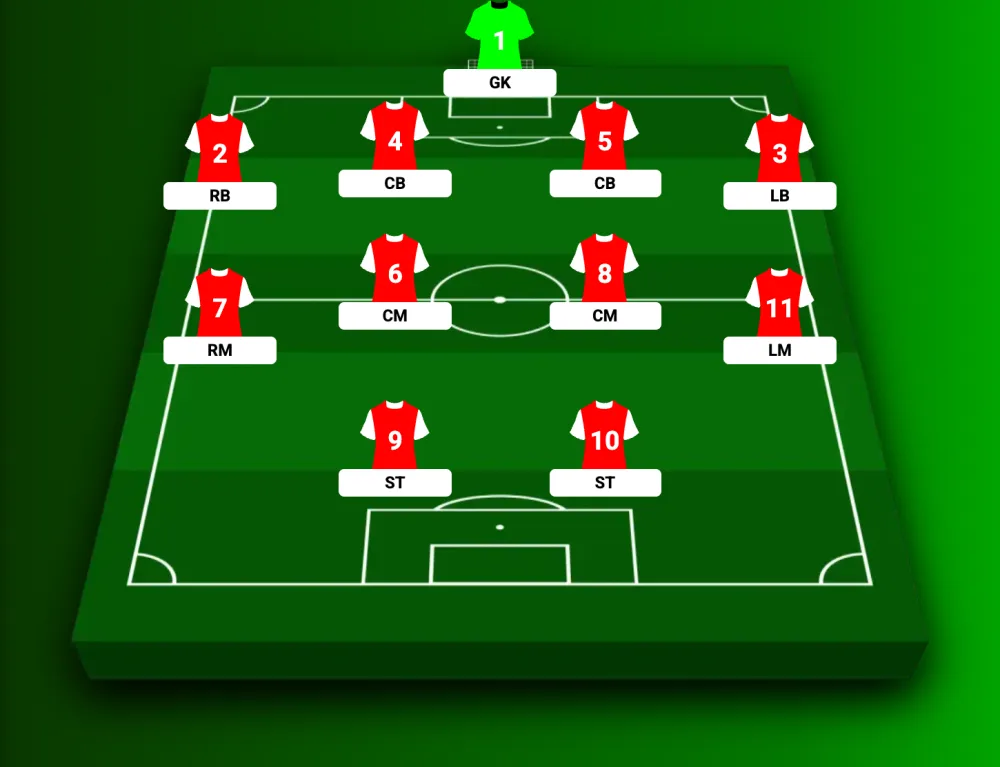
In a 4-4-2 the wingers become wide midfielders with a much longer defensive shift, and the 10 stops being a playmaker behind the striker. It becomes a second forward, dropping a few yards to link play. The 6 and the 8 sit next to each other rather than in a line, so one holds while the other pushes on, and they swap depending on who has the ball.
The 4-2-3-1 splits the difference and gives the clearest picture of the modern midfield trio:
Two holders, then a 10 in the pocket, then a lone 9. This is the shape that made "the 6" a household term, because with two players screening the defence you can finally see which one is doing the screening.
If you want the wider map of how these systems relate, the formations guide covers fourteen of them side by side.
The numbers mean different things abroad
Do not assume the English mapping travels.
In Argentina, the numbering follows a 4-3-3 tradition where the 4 is the right back and the 2 is the first centre back, which is why an Argentine "cuatro" is a defender out wide rather than a central one.
In Brazil, the numbering descends from the 4-2-4, and the 10 is understood as a midfield position rather than a forward one. That is the lineage behind the Brazilian idea of a 10 as the team's creative hub.
Say "he's a classic 4" to a coach in Buenos Aires and to a coach in Manchester and you have described two different players.
Which position suits a beginner?
Two answers, and neither is striker.
Full back. One flank, one main responsibility, and far less traffic than the middle of the pitch. You learn when to step in and when to hold your line without twenty-two players moving around you at once.
Central midfield. You will touch the ball more than in any other outfield position, and touches are how you get better. The trade-off is that everything happens quickly and from all sides.
Goalkeeper and lone striker are the hardest starting points, because both are isolated and both make mistakes that everybody sees.
Put the numbers on a pitch
Reading a table is one thing. Seeing your own eleven arranged is another, and it is the fastest way to notice that your team has two 10s and nobody willing to be the 6.
Every diagram above was made with the same tool, in about a minute each: set the squad to 11, pick the formation, then edit each player's name and shirt number. You can do the same on the lineup builder, or start from a real squad if you would rather see how a professional side lines up.
If you are still working out how many players you need in the first place, every format is broken down here, from 5-a-side up to the full eleven.
One last thing worth knowing. The reason "number 6" survived while "inside right" died is that the 6 still describes a job somebody has to do. Somebody has to stand in front of the defence. Nobody has to stand where the inside right stood, because that space stopped existing in about 1935.